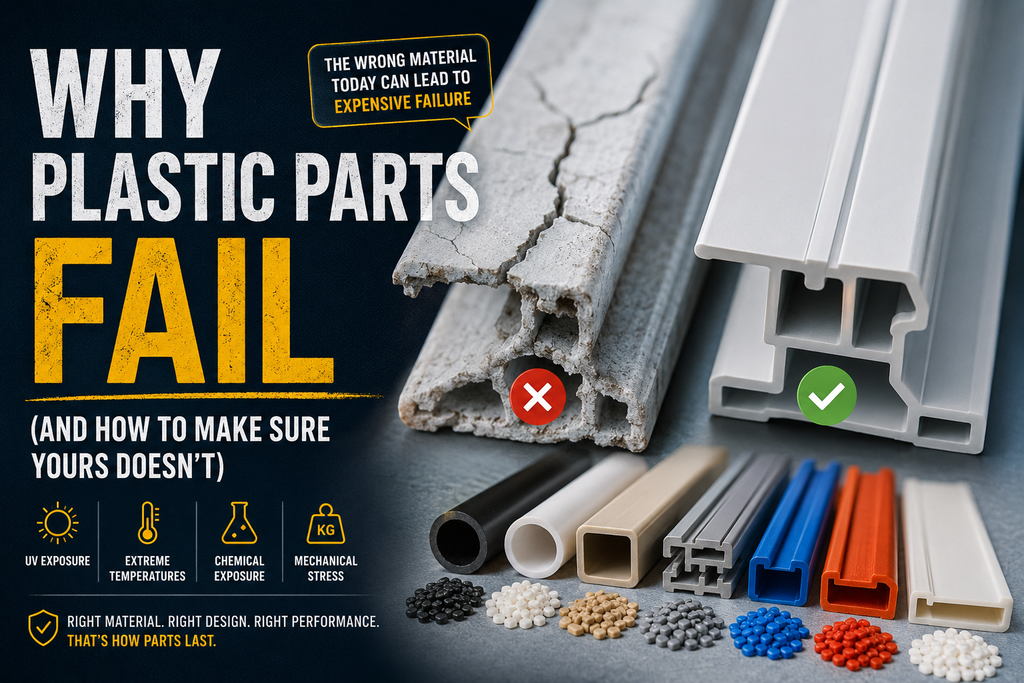
Most plastic parts do not fail because of bad manufacturing. They fail because the wrong material was chosen before manufacturing even began. Studies on plastic part failure point to material misselection as the biggest single cause, ahead of poor design or a bad production run. We are sharing out experience about how close this came to happening to someone just like you, and what changed the outcome.
You have already picked a material for your product. Or you are about to.
It probably felt like an easy decision. Cheap, familiar, something a competitor already uses.
But here is the question nobody asked you yet. Where is this product actually going to end up?
Not just this year. In two years. In five.
That one question is the difference between a part that lasts and a part that quietly fails long after you have stopped thinking about it.
What You’ll Learn
| Question | Where to find it |
| Why do plastic parts actually fail? | The real cost of picking the wrong material |
| Could this happen to you too? | A real story that almost went wrong |
| Which plastic suits your product? | How each plastic performs in the real world |
| How do you pick plastic for outdoor or UV use? | Choosing plastic for outdoor and UV exposure |
| Are you making a mistake you don’t even know about? | Common mistakes buyers make |
| How would a good manufacturer protect you? | How we check material before it becomes a part |
| What should you ask before you commit? | Questions to ask before you choose a material |
The Real Cost of Picking the Wrong Material
Your plastic part will probably not fail on day one.
It will fail months later. After it has shipped. After your customer has already installed it. After fixing it costs ten times more than it would have at the start.
Cracking. Warping. Discoloration. On the surface, these look like manufacturing problems.
They almost never are. The real mistake happened earlier, quietly, the day someone picked a material because it was cheap or familiar, without asking what it would actually face.
This guide is not about which plastic wins on a spec sheet. It is about helping you ask the one question that matters before you commit to anything.
Our Experience With A Client That Almost Went Wrong
Picture yourself in this seat for a moment.
You are an R&D engineer with a new custom part. You know your first market well. You have a rough idea where things go after that.
That was exactly the position a client of ours was in. His plan was simple. Launch in Punjab and Sindh first. Expand across Pakistan next. Go global eventually. His material choice was ABS.
Honestly, ABS handles Pakistan’s climate well. It is a common, sensible pick for consumer facing parts.
Then he mentioned something almost as an afterthought. Europe was part of that “eventually.” Specifically the UK, then later the US. He did not think it mattered yet. It was years away.
It mattered more than anything else in the whole conversation.
Here is why this matters to you too, not just him. Pakistan’s climate is mild compared to what the UK and US can do to a plastic part. Recorded extremes in the UK reach close to 40 degrees Celsius in summer and drop to around minus 27 in winter. The US swings even harder, from around 56 degrees Celsius down to nearly minus 62 in its coldest regions.
ABS was never built to survive swings like that. Extreme cold makes it brittle. Sustained heat softens it and pulls it out of shape.
So we gave him two honest, separate answers.
For Pakistan, we recommended PVC instead of ABS. Not because ABS was wrong, but because PVC was more cost effective for this stage, and it handles local conditions just fine. That decision was genuinely his to make. Either material would have worked here.
For the future Europe and US launch, we pointed him toward something different entirely. PTFE, a specialty engineering plastic that barely notices extreme heat or extreme cold. It costs more. But it is built for exactly the punishment PVC and ABS were never designed to survive.
He chose the phased approach. Affordable now, protected later.
It worked out well for him.
Now ask yourself honestly. If you were in his seat, would you have mentioned Europe? Or would it have stayed a small detail, the kind that quietly turns into an expensive mistake three years from now?
How Each Plastic Performs in the Real World
Every plastic has a personality. Once you know what yours is naturally good at, the guessing stops. As a custom plastic material manufacturer, this is the exact conversation we have with buyers every week.
Where Each Material Actually Stands: Heat, Cold, UV, and Cost
Before you pick anything, it helps to see the full lineup side by side. This is not about finding the single best plastic. It is about finding the one that matches what your part will actually go through.
The ranges below are approximate on purpose. Real performance depends on the exact grade, additives, wall thickness, mechanical load, and how long the part is exposed to these conditions. Use this as a starting point for a conversation with your manufacturer, not as a guarantee.
| Material | Approx. continuous service temperature | Approx. cold capability | Relative raw material cost in Pakistan | Outdoor / UV suitability | Typical applications |
| PVC | Up to about 60°C | Good down to about minus 15°C, grade dependent | Low | Poor unless UV stabilised, good once it is | Window profiles, cable trunking, pipes |
| ABS | Up to about 80°C | Moderate, can turn brittle below about minus 20°C | Low to Medium | Poor for long term direct sun unless painted or coated | Product housings, automotive interior trim |
| HDPE | Up to about 80 to 100°C | Very good, stays tough down to about minus 40°C | Low | Good, especially in UV stabilised or carbon black grades | Pipes, tanks, drainage, outdoor structural parts |
| PP | Up to about 90 to 100°C | Fair, standard grades can turn brittle near 0°C | Low | Poor unless stabilised | Packaging, snap fit lids, lab consumables |
| ASA | Up to about 80 to 90°C | Moderate, similar to ABS | Medium | Excellent, built specifically for weather and UV exposure | Outdoor housings, signage, automotive exterior trim |
| Polycarbonate (PC) | Up to about 120 to 130°C | Very good, stays tough down to about minus 40°C | Medium to High | Moderate, yellows over time unless UV coated | Safety shields, machine guards, lenses |
| Nylon (PA6 / PA66) | Up to about 80 to 120°C, grade dependent | Fair to good, grade dependent | Medium to High | Poor unless stabilised | Gears, bushings, mechanical wear parts |
| PVDF | Up to about 150°C | Good, stays usable down to about minus 40°C | High | Excellent, one of the most weather stable plastics available | Chemical processing, high purity piping |
| PPS | Up to about 200 to 220°C | Good, stable at low temperatures too | Very High | Moderate, usually chosen for heat and chemicals, not for outdoor use on its own | Under the hood automotive parts, electrical connectors |
| PTFE | Up to about 260°C | Excellent, works well into extreme cold too | Very High | Excellent, virtually unaffected by UV | Seals, gaskets, chemical resistant linings |
| PEEK | Up to about 250 to 260°C | Excellent, stays tough in extreme cold too | Extremely High | Good, though it is rarely chosen for UV reasons alone | Aerospace, medical, high performance mechanical parts |
What This Means for Your Product
None of this means the most expensive material automatically wins. It means the right material depends on what your part will actually face.
PVC works well for a lot of construction and profile applications, as long as it is properly UV stabilised for outdoor use. ABS is excellent for consumer and indoor or semi outdoor products, but standard ABS is not the same thing as weather resistant ABS or ASA. Treating them as interchangeable for long term outdoor use is exactly the kind of assumption that causes failure later.
HDPE earns its place wherever chemical resistance, moisture, and outdoor durability all matter at once. PP stays useful and affordable almost everywhere, but the specific grade matters if your part will see cold temperatures or direct sun for years. ASA exists specifically for weather and UV heavy applications where standard ABS would eventually let you down.
Polycarbonate is worth the extra cost when impact resistance and a wider temperature range genuinely matter. Nylon earns its keep in mechanical, higher temperature applications, again depending on the exact grade. PVDF, PPS, PTFE, and PEEK sit in a different category entirely. These are specialty materials for applications where ordinary plastics cannot deliver what is required, not upgrades you reach for by default.
Why This Connects Back to Failure
The right material is not the material with the highest temperature rating. It is the material that gives your part enough performance for the environment it will actually face, at a cost that still makes sense for your business.
Pick a material with too little thermal, UV, chemical, or impact performance for the job, and you are not saving money. You are borrowing time. Eventually that shortfall shows up as cracking, warping, discoloration, brittleness, or dimensional instability, and it shows up as customer complaints and a costly replacement, not as the manufacturing defect it might look like on the surface.
This is exactly why outdoor and UV exposure deserves its own closer look a little further down, since it is one of the most common places this mistake shows up first.
If you are building for construction, look at PVC. As a PVC plastic profile manufacturer for construction, we build profiles that earn their reputation the hard way, surviving years of sun, rain, and temperature swings without falling apart. It is affordable, chemical resistant, and can be made UV stable for outdoor use. See our PVC manufacturing page for the grades we run.
If your product needs to look good on a shelf, ABS is probably your answer. As an ABS plastic parts manufacturer for consumer products, we see this material take paint and finishing beautifully, resist everyday drops and knocks, and hold its shape under handling. That is exactly why so many consumer product shells lean on it. Full details on our ABS manufacturing page.
If your part will face acids, alkalis, or solvents, HDPE has your back. As an HDPE plastic products manufacturer for chemical resistant applications, we see this material shrug most chemicals off without blinking, and it barely absorbs water either. Chemical storage, drainage systems, and tough outdoor parts all depend on it. More on our HDPE manufacturing page.
If you need something light, food safe, and budget friendly, that is PP. Our pp plastic products resist cracking even after thousands of flexes, which is why packaging and snap fit lids trust this material constantly. Details are on our PP manufacturing page.
If your part simply cannot be allowed to crack, reach for polycarbonate. As a polycarbonate parts manufacturer for impact resistance, we work with a material that is roughly 250 times more impact resistant than glass, and it stays clear while doing it. Safety shields and machine guards are built on this exact strength. See our polycarbonate manufacturing page.
If your part sits somewhere genuinely hot, standard plastics will let you down. As an engineering plastics manufacturer for high temperature applications, we lean on grades like nylon, which handle sustained heat far better, and specialty materials like PTFE go even further, the way it did in the story above. Our nylon manufacturing page covers our standard high heat capability.
One honest note if you were thinking about acrylic plastic products. Acrylic is not currently on our confirmed material list. Ask us directly and we will tell you the truth, even if that truth points you somewhere else entirely.
Choosing Plastic for Outdoor and UV Exposure
Which plastic material should you choose for outdoor UV exposure? This is one of the questions we get asked the most, and it deserves a straight answer.
Sunlight is patient. It will not break your part in a day.
It fades it first. Slowly dries it out over months. Then one ordinary day, it just cracks, and you will wonder why.
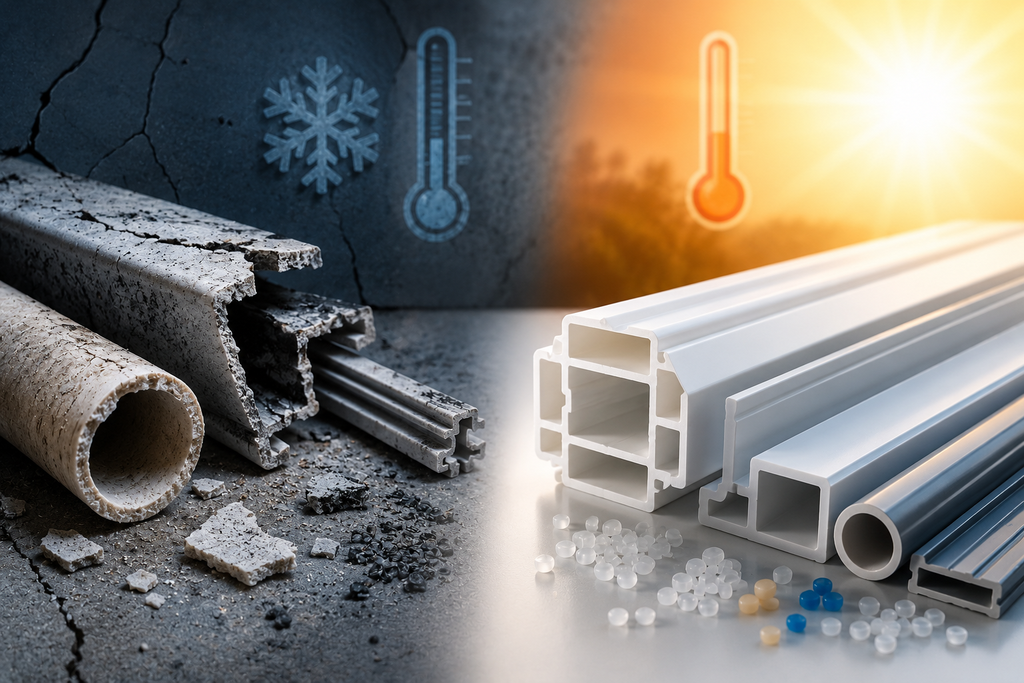
The fix is not some exotic material. It is the UV stabilised version of the material you already need. UV stabilised PVC and UV rated PP are both affordable and proven, and HDPE handles sun exposure well on its own.
Want a full side by side comparison across everything we process? Our material selection guide breaks down temperature, chemical exposure, and cost in one place. Building for construction specifically? Our construction industry page covers how we apply UV stabilisers to PVC.
Common Mistakes Buyers Make
Here is an uncomfortable question. Are you sure you are not making one of these right now?
Most material mistakes are not caused by ignorance. They are caused by silence, the kind that almost cost our client above his Europe expansion.
You describe today’s use case in detail, but do you mention where the product might end up in two years? Price often becomes the only variable, even when a cheaper material simply will not survive the job. And it is easy to assume a standard looking part can be ordered like a standard product, without ever discussing the real conditions it will face.
None of this comes from carelessness. It comes from nobody asking you the right question yet.
How We Check Material Before It Becomes a Part
This is what a good manufacturer does for you, quietly, before you ever see the finished part.
Before production starts, we inspect the raw material itself. Color consistency, contamination, melt stability, all checked before a single machine turns on.
During trial runs, we watch for dimensional drift and surface defects like flow marks or die lines. After extrusion, every batch is checked again for wall thickness, straightness, and color, before it ever leaves the floor.
We also see the other side of this often. A buyer brings us a part made elsewhere that has started failing, and the warning signs are almost always the same. Uneven color within one profile. A dull, rough surface. Visible black specks. A crack on a simple bend test.
If you spot any of these on a sample from your current supplier, that is your moment to ask hard questions before you commit to a full order.
Questions to Ask Before You Choose a Material
A five minute conversation before tooling starts can save you months of pain later.
Before you commit to a material, make sure your manufacturer actually asks you these questions. If they do not, ask yourself why.
- Where will this part be used, both now and in your future plans?
- What temperature range will it face, including the extremes, not just the average?
- Will it touch any chemicals, oils, food, or water?
- Does it need to flex, or does it need to stay rigid?
- What is your real budget, and does that budget match the environment the part will actually face?
A manufacturer who asks these before quoting you is protecting you. One who quotes instantly, without asking a single one, is quietly betting that nothing about your application matters. It almost always does.
Frequently Asked Questions
1. Why do plastic parts fail most often?
The leading cause is material misselection. A plastic that cannot handle the real temperature, chemical exposure, or physical stress it will face, not a defect in how it was manufactured.
2. How do I know which plastic is right for my product?
Start with three questions. What temperature range will it face? Will it touch chemicals or food? Does it need to flex or stay rigid? Our material selection guide walks through the rest.
3. Can the same product need different materials in different countries?
Yes, and the story above is proof. A part built for Pakistan’s climate can need a completely different material once it is headed somewhere with far more extreme temperature swings.
4. Is a cheaper material always a mistake?
No. For an early stage, cost sensitive launch in a moderate climate, the more affordable material can be exactly the right call, the way it was for the Pakistan phase of the story above.
5. Does PlasCity help with material selection or just production?
Both, always. Our chemical engineers review your application before you commit to anything, and we will tell you honestly if a cheaper or different material serves you better.
Why Buyers Trust PlasCity With Material Decisions
We have been doing this since 1978. Third generation now, still family run, still answering the phone ourselves.
Thirteen extrusion machines. Every die and mould designed and made in house. Chemical engineers on staff for exactly the kind of question this guide is built around.
Over 3,000 products completed across more than 60 industries. And a simple rule we still follow for every client, including you. We would rather recommend the right material at a smaller margin than sell you the wrong one at a bigger one.
Not sure which material fits your project? Send us your application details and we will walk you through it honestly, the same way we did for the engineer in this story. Request a free quote here, message us on WhatsApp, or check our Google Business Profile to see what other clients say about working with us. Curious how the profiles themselves get made? Read our guide on what plastic extrusion is.