We get the same message again and again. A buyer sends a photo of a plastic profile and asks two questions: “What will the product cost, and what will the die cost?”
We want to answer. We can’t, not from a photo. This guide shows you what we need instead, and what happens at every step between your first enquiry and your bulk delivery.
The short answer: Send us a physical sample or a CAD drawing, plus your material, colour, piece length and monthly or yearly volume. We review your application, build the die, and run trial samples for you to test in your own assembly. You approve a sample, and only then do we start production.
At PlasCity, we make dies and moulds in 10 to 40 days, depending on their nature. Our minimum order is 3,000 metres for extrusion and 5,000 pieces for injection moulding.
This guide is for procurement managers, OEM buyers, contractors and importers who need plastic profiles made to their own design, in volume. In the local market, people call these products plastic sections or patti. We say “profile”, and everything here applies to all three names.
New to extrusion? Read how plastic extrusion works first, then come back.
The facts at a glance
| Question | Answer |
|---|---|
| What should I send? | A physical sample or a CAD file |
| Can you price from a photo? | No |
| How long does a die or mould take? | 10 to 40 days, depending on its nature |
| Minimum order, extrusion | 3,000 metres |
| Minimum order, injection moulding | 5,000 pieces |
| Materials | PVC, ABS, HDPE, PP, LDPE, LLDPE, PET, nylon, polycarbonate |
| Capacity | 13 extrusion lines, about 600,000 metres of profile per month |
| Where | Ferozewala, Punjab, Pakistan, with delivery across Pakistan and export |
The order journey in seven steps
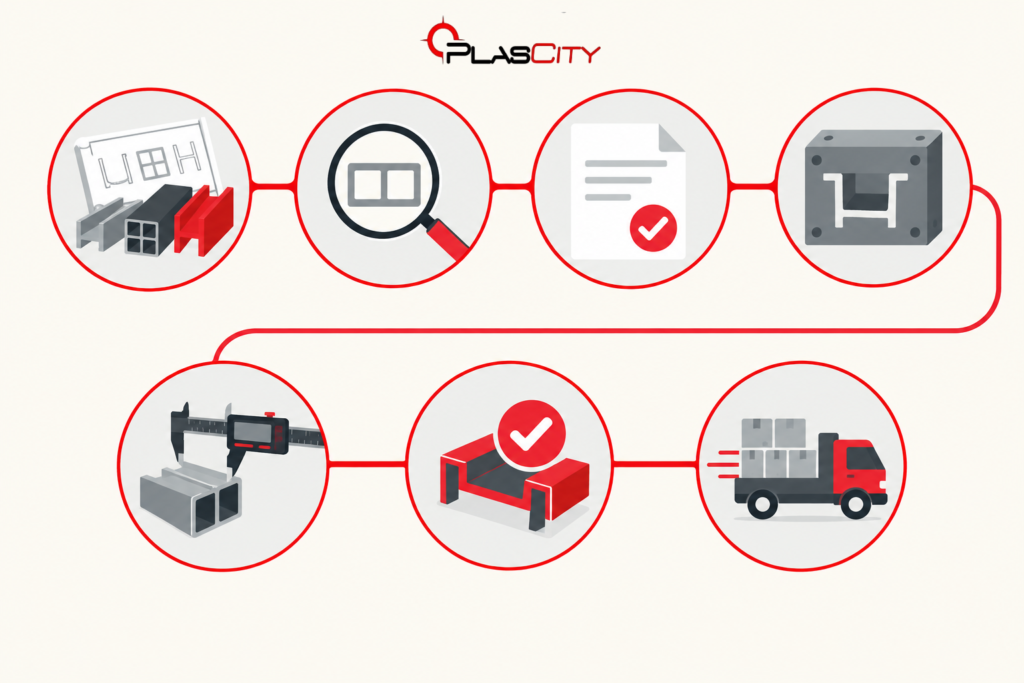
- You send a sample or CAD file with your requirements.
- We review your application and tolerances.
- We price the job, and you approve the quote.
- We build the die or mould in house.
- We run trial samples, and you test them in your assembly.
- You approve a sample. We revise until you do.
- We produce, pack and deliver. Your approved sample guides every reorder.
Each step hides a trap. Step 1 looks simple, but it is where we answer the most questions, so we start there.
What do you need to send before you order?
You need four things: the shape, the application, the volume and the finish.
The shape. Send a physical sample or a CAD file. If you only have a part in your hand, send that. We reverse engineer profiles from samples and build the drawing ourselves.
The application. Tell us how you use the profile. Does sunlight, chemicals, cold or heat reach it? Does it carry a load? Do you fix it once, or assemble and take it apart again and again? What does it connect to?
We learned this one the hard way. Early on, we focused only on matching the customer’s drawing. One profile matched the drawing perfectly and still did not fit smoothly on the customer’s assembly line, because nobody had asked how workers installed it. A small die adjustment fixed it. Now we discuss function, assembly method, operating environment, volume and critical tolerances before we make any die. We also ask for your mating parts, so we can test in real conditions.
The volume. Give us your first order quantity and your monthly or yearly volume. The first order sizes the run. The yearly figure helps us plan material and line time.
The finish. Tell us the colour and the cut length. We make custom colours and lengths to your requirement.
Copy this checklist into your enquiry:
| Item | What to send |
|---|---|
| Shape | Physical sample or CAD file (a photo alone cannot be priced) |
| Material or performance need | PVC, ABS, HDPE, PP, or the properties you need, such as flexible, rigid or UV exposed |
| Critical tolerances | The two or three dimensions that must stay exact. A tolerance is how far a dimension may drift from your drawing. |
| Colour | A colour reference or a physical swatch |
| Piece length and quantity | Length of each piece, and how many pieces you need |
| Monthly or yearly volume | Your best estimate |
| Operating environment | UV, chemicals, temperature, load |
| Mating parts | The parts the profile connects to |
| Delivery location and date | City or port, and the date you need it |
When your enquiry arrives, we review your application and tolerances before we price anything. If we see a way to cut material use or improve fit, we tell you before we cut the die.
No CAD file yet? Send a sample, or describe what the profile must do. We work from customer drawings, CAD files and technical specifications, and we handle reverse engineering and prototype development in house.
Why can’t we price a job from a photo?
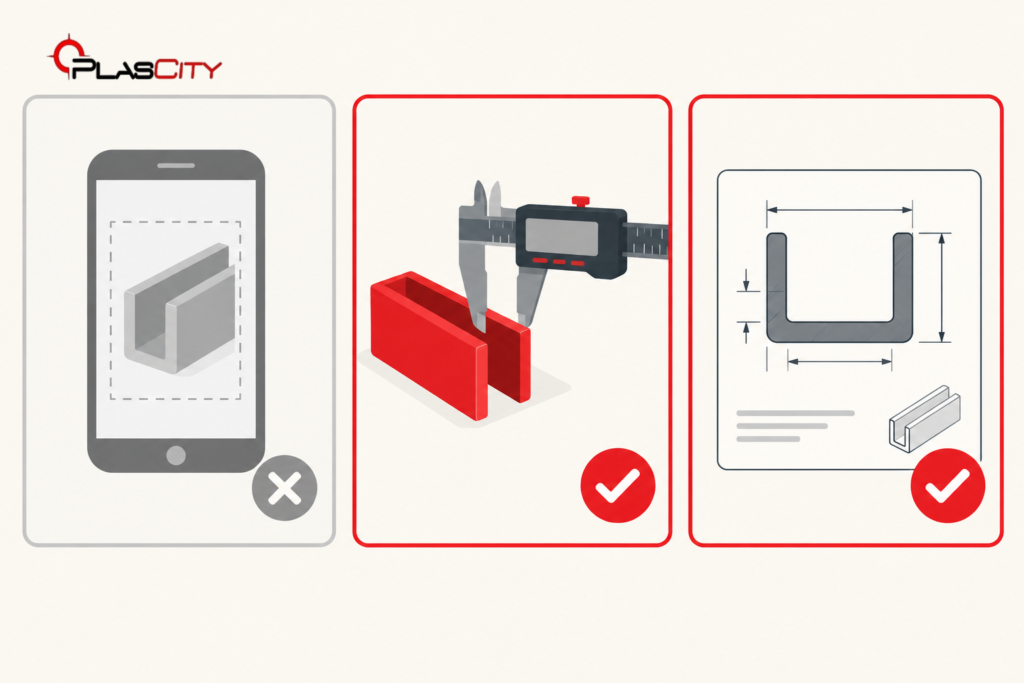
Here is the part that surprises people: the photo is not the problem. The missing information is.
A photo shows us the shape. It does not show us the size, the wall thickness, the internal features or the tolerances. Those four things decide almost everything: how large the die must be, how long it takes to build, what it costs, how much material each metre uses, and what the finished product costs.
When you send a physical sample or a CAD design, we measure all of it. Then we can tell you how large the die will be, what it will cost to make, what product will come out of it, and what that product will cost.
Send the photo anyway if it helps explain your idea. We enjoy those conversations. Just send the sample or the CAD file when you want a number you can budget on.
How do you tell us how much you need?
Our next question usually creates a pause: “How much do you need?”
Extruded profile comes in any length, so buyers wonder whether to answer in pieces, metres, feet or inches. Any of them works. Tell us two things: how long each piece is, and how many pieces you need. Or give us the total length.
| Unit | Piece length | Pieces | Total length |
|---|---|---|---|
| Metres | 4 m | 1,000 | 4,000 m |
| Feet | 4 ft | 3,000 | 12,000 ft (about 3,658 m) |
| Inches | 4 in | 100,000 | 400,000 in (about 10,160 m) |
Extruded profile leaves the line as one continuous length, so we plan production in total running length. Not sure how to calculate yours? Send the piece length and the piece count, and we do the maths.
How do you compare two quotes fairly?
Before you compare two prices, answer one question: which material is each quote for?
Every plastic has its own price. PVC, ABS, HDPE, PP, nylon and polycarbonate are not interchangeable, and even inside one material, the grade and the additives change the cost. See the material options we work with to understand the differences.
A lower quote can also come from recycled or reprocessed plastic. Each time plastic is melted and processed again, it can lose strength, impact resistance and colour stability, and the stabilisers that protect it get used up. How much it loses depends on the material and how many times it has been processed. You cannot see any of that on a quote. That is why a recycled price next to a virgin price is not a fair comparison.
We believe in quality, so we use virgin material by default and add strength enhancing additives where the job needs them. That is often the reason our price is higher. If you want recycled material for a specific reason, tell us, and we will work with it. Then it is your informed choice. To learn how to tell the difference yourself, read how to spot recycled plastic before it wrecks your product.
Line up your quotes before you compare them. Make sure each one covers:
- The same material and grade, and whether it is virgin or recycled
- The same additives, such as UV stabilisers or strength enhancers
- The same drawing, tolerances, colour and piece length
- The same scope: die, trial samples and revisions
How long does a custom profile order take?
Most of the waiting happens before the first metre runs, so here is the honest version.
Die and mould manufacturing usually takes 10 to 40 days, depending on the nature of the die or mould. A simple profile die sits toward the short end. A complex profile or an injection mould takes longer.
| Order route | What happens | What to expect |
|---|---|---|
| New custom profile | Design review, die, trial samples, your approval, production | The die comes first, usually 10 to 40 days |
| Complex new profile | The same steps, with more die adjustment | We built tooling for a refrigeration glass door and wire shelf profile in about two weeks |
| New injection moulded part | Mould design, mould build, trials, approval | Depends on the size and complexity of the mould |
| Reorder of an approved profile | We use the existing die and your approved sample | No new die, so the order moves straight to planning and production |
Because we develop dies and moulds in house, we never wait on an outside tool maker. That is where many sample delays start. See our manufacturing process for the full sequence.
Once tooling and approvals were in place, we delivered 50,000 metres of food grade and medical tubing in 6 days, and 40,000 HVAC components in 11 days. These examples show what is possible after approval. They are not a promise for every job.
Four things slow an order down:
- Drawings or samples that are incomplete, or that change after we cut the die
- No agreed colour standard before sampling
- Slow sample approval, because we cannot start production until you sign off
- A change of material after trials begin
Settle shape, material and colour before we make the die, and you shorten your lead time more than any machine can.
What is the minimum order?
Our minimum order is 3,000 metres for extruded profiles and 5,000 pieces for injection moulding.
A minimum exists because production needs setup before it makes one usable piece. We bring an extrusion line up to temperature, calibrate it and let it stabilise. For injection moulding, we install the mould, load the material and settle the process. Short runs spread that setup over very little output, so the price per unit rises.
We run 13 extrusion lines with a capacity of about 600,000 metres of profile per month, so a bulk order sits comfortably inside our planning. For scale, 3,000 metres equals about 9,840 feet. Not sure whether your volume fits? Send your monthly or yearly estimate, and we will tell you honestly.
You now have a quote, a timeline and a minimum. One step protects your money more than all three: the sample.
How do you approve a sample before mass production?
Never release a bulk run without approving a sample. We make the sample from the finished die on a real production line. It is your chance to catch problems while they are still cheap to fix.
Check these on the sample:
- Critical dimensions against your drawing
- Wall thickness
- Straightness
- Surface finish
- Colour against your reference
- Piece length
- Fit with your actual mating parts, not only the drawing
Fit is the check most buyers skip. A profile can match the drawing and still fail on your line, as our own early lesson showed. Install the sample in your real assembly. Test how it slides, clips or seals, and check it in the conditions it will face.
Revisions are normal. We offer multiple revisions until you approve the sample. In the refrigeration case, the client asked for one fit adjustment. We revised the die quickly, and the next trial passed. Then we ran production with in process monitoring and batch traceability, delivered on schedule, and the client placed repeat orders. See our quality checks for how we inspect profiles.
Write down which sample you approved, and keep one yourself. We judge production against that sample.
What should you confirm before production starts?
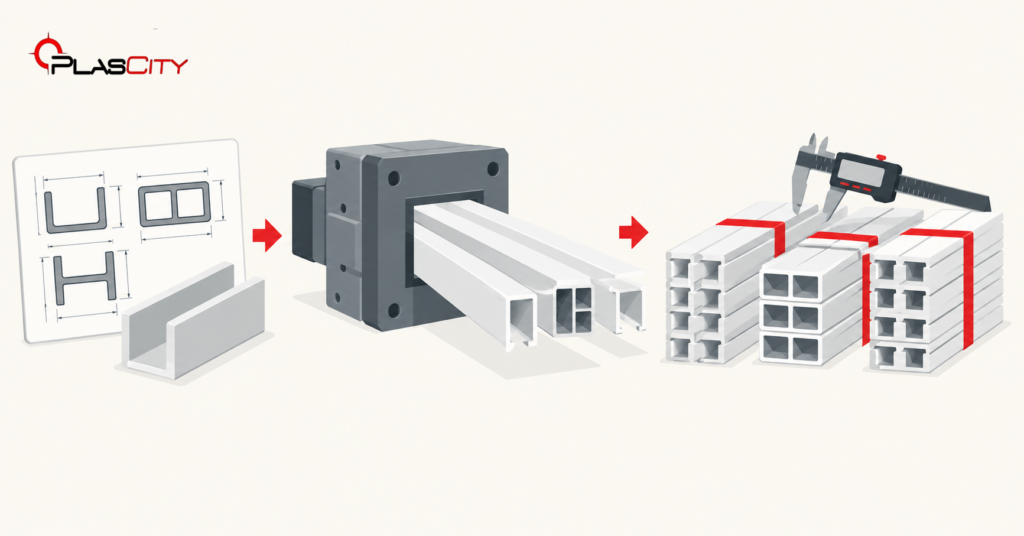
Put these points in writing before we run your bulk order:
- Drawing revision and approved sample reference
- Material, grade and colour
- Total quantity and piece length
- Packing method
- Delivery address and date
- Payment terms
- How you will handle changes after approval
- Who holds the die, and where we store it
Pay special attention to the last one. A die is a tool built for your profile, so agree in writing who owns it and where it lives.
We pack your products carefully and support delivery to your doorstep. After the order ships, we stay available for aftersales support, because most of our work comes from long term relationships and repeat orders. We recommend you confirm any change before sampling or production, never during a run.
For export orders, agree the Incoterms in writing. These are the International Chamber of Commerce’s standard trade terms. EXW means you collect the goods at the factory. FOB means the manufacturer loads the goods onto the vessel at the port, and it applies to sea freight only.
Where do we work from, and how do orders reach you?
Our factory is in Ferozewala, near Lahore, Punjab. We deliver across Pakistan, including Karachi, and we support export shipments. We welcome factory visits by appointment, so you can inspect production, review samples and talk to our technical team directly.
Quick glossary
| Term | Meaning |
|---|---|
| Die | The tool that shapes molten plastic into your profile |
| Mould | The tool that shapes injection moulded parts |
| Tolerance | How far a dimension may drift from your drawing |
| Cut length | The length each profile piece is cut to |
| Trial sample | A piece we make from the finished die for you to test |
| MOQ | Minimum order quantity |
| Reverse engineering | Measuring a physical part to create a drawing |
Frequently asked questions
How do I order custom plastic extrusion profiles?
Send a physical sample or CAD file, plus your material, colour, piece length and monthly or yearly volume. We review the design, build a die, run trial samples, and start production after you approve one.
Can you give me a cost from a photo?
No. We cannot calculate product cost or die price from an image. We need a physical sample or a CAD design to see how large the die will be, what it costs to make, and what the finished product costs.
How do I state how much I need?
Tell us the length of each piece in metres, feet or inches, and how many pieces you need. Or give us the total length. For example, 1,000 pieces of 4 metres is 4,000 metres in total.
Can I order from a sample without a drawing?
Yes. We reverse engineer a profile from your physical sample and develop a drawing and prototype from it.
How long does a die or mould take?
Die and mould manufacturing usually takes 10 to 40 days, depending on the nature of the die or mould.
What is the minimum order?
3,000 metres for extrusion and 5,000 pieces for injection moulding.
Why is another manufacturer’s quote cheaper?
Check which material the quote covers. Prices differ by material and grade, and a lower price may reflect recycled material, which you cannot fairly compare with virgin material.
How many sample revisions do I get?
As many as it takes until you approve the sample.
Which materials do you work with?
We work with PVC, ABS, HDPE and PP, and also LDPE, LLDPE, PET, nylon and polycarbonate, made to your drawings and specifications.
Do you deliver, and can I visit?
We support delivery to your doorstep in Pakistan, and we handle export orders. You can visit the factory by appointment.
Ready to order? Send us your sample or CAD drawing
Send your physical sample, CAD drawing or technical specification, along with your material, colour, piece length and monthly or yearly volume. We review your application and come back with a clear plan for your custom plastic extrusion profile.