Search for a plastic manufacturer in Pakistan and you will find the same thing everywhere. A long directory of company names, and almost nothing about how an export order really works.
Nobody explains who owns the die. Nobody explains which trade term protects you. And nobody warns you about the duty line that changed this summer.
That is the gap this guide fills. And one of these topics costs buyers more money than all the others combined. I will get to it.
Short answer: Yes, an OEM buyer can source custom plastic parts and profiles from a Pakistani manufacturer. It works when you lock four things in writing before production starts: trade terms, payment terms, tooling ownership and a pre shipment inspection.
I run a plastic manufacturing business in Pakistan, so I am writing from the other side of the table. That also means I will give you the same checks I use myself.
What You’ll Learn
| Topic | What you get |
|---|---|
| Pakistan versus China | Where Pakistan fits and where it does not |
| Trade terms | FOB, FCA, EXW and CIF in plain words |
| Payment | Which method suits a first order |
| Tooling ownership | What to put in writing before you share a drawing or pay for a die or mold |
| Documents, HS code and shipping | What the shipment needs and how long it can take |
| Duties and inspection | The US duty check, the EU position, and how to inspect before shipment |
Plastic Manufacturer Pakistan vs China: Where Pakistan Fits for OEM Buyers
In my experience, Pakistan suits OEM buyers who want focused, repeat orders and a direct line to the people running the machines.
Pakistan has a large, established plastics sector. Most of its processing units are in Punjab and Sindh.
One practical tip first. Material prices move, so ask every manufacturer how long a quote stays valid.
| Factor | Pakistan | China | What to check |
|---|---|---|---|
| Manufacturer choice | Focused base, direct contact with the team running your order | Very large base, so more manufacturers to vet | Ask for samples of parts similar to yours |
| Extra US duty, October 2026 | 10% | 12.5%, plus older China specific duties on some products | Check your HS code on the day of entry |
| Sea route to Europe | Karachi and Port Qasim, with a weekly direct MSC service to Europe restored in October 2026 | Many ports and routes | Ask your forwarder for the current schedule |
Compare landed cost, not factory price: product price, freight, duty and port fees. On the US side, Pakistan currently carries a lower extra duty than China.
Now the part most guides skip. Even with the right country, a first order can go wrong in four places. We will take them one by one.
Pakistan Plastic Exporter for OEM Buyers: What Changes When an Order Crosses a Border
Once your sample is approved, an export order adds five steps to normal production:
- Production against the approved sample
- Pre shipment inspection
- Export clearance in Pakistan
- Sea or air freight
- Import clearance at your end
Quotes, samples and minimum order sizes are a separate topic. We cover them in our bulk ordering guide for custom plastic extrusion profiles. For contract and OEM work in detail, see our OEM plastic manufacturer guide. For molded parts, see our injection molding manufacturer guide.
In my experience, delays rarely start in production. They start in paperwork, ports and unclear terms. So let us begin with the term that decides who pays for what.
Incoterms for Pakistan Plastic Exports: FOB, FCA, EXW and CIF Explained
For a first order, FCA or FOB is usually the safer choice for the buyer. EXW pushes export clearance onto you, and CIF hides a risk most buyers miss.
Incoterms are rules published by the International Chamber of Commerce. Incoterms 2020 is the current edition. They set who pays for what and when risk passes. They say nothing about payment.
| Term | Export clearance | Main freight | Risk passes to you | Fits |
|---|---|---|---|---|
| EXW | Buyer | Buyer | At the factory | Rarely wise for a first order |
| FCA | Seller | Buyer | When handed to your carrier at the named place | Container shipments |
| FOB | Seller | Buyer | When loaded on the ship | Sea freight where you choose the carrier |
| CIF | Seller | Seller, with minimum insurance | When loaded on the ship | Simple quotes, but check the cover |
Look at CIF again. The seller pays freight and insurance to your port, yet risk passes to you at loading. If the container is damaged at sea, you are the one dealing with the claim.
CIF insurance is minimum cover by default. Ask for wider cover or arrange your own.
Whatever you choose, name the term and the port in the quote. FOB Karachi means something. FOB alone does not.
Payment Terms for Pakistan Plastic Exporters: Advance, Letter of Credit or Open Account
For a first order with a new manufacturer, most buyers use cash in advance or a letter of credit. Open account, where you pay 30 to 90 days after delivery, carries the most risk for the manufacturer, so it usually comes later, once trust is built.
Trade bodies list five methods: cash in advance, letter of credit, documentary collection, open account and consignment. Cash in advance is the safest for the seller and the hardest on your cash flow.
A common middle path is a deposit to start production and the balance against shipping documents. Many first orders follow this pattern. Write the split into the purchase order.
A letter of credit adds bank protection, but the documents must match its terms exactly. One small mismatch can stall payment and your shipment with it. Check the draft wording with your bank before anything ships.
Plastic Tooling Ownership and NDA in Pakistan: Who Owns the Die or Mold?
If you read only one section, read this one.
You own the tooling only if a written agreement says so. Paying a tooling invoice does not transfer ownership by itself.
This is where many overseas orders turn into disputes. A buyer pays for a die, changes manufacturer a year later, and then learns the die stays at the factory.
There are three common models: customer owned, manufacturer owned, or amortized into the part price with a transfer at the end. Each can work. None works without a written clause.
Put these in writing before you pay:
- When ownership passes to you, for example on final payment
- Which items are covered: the die, calibrators and any fixtures
- That the tool is marked with your company name and a tool number
- Where it is stored, who maintains it and who pays for repairs
- That it can be released to you or to another manufacturer on request
- Whether any part of the tooling is made by a subcontractor
- Who owns the design files and drawings, and that they stay confidential under a signed NDA
The subcontractor point matters more than it looks. Tooling is often built by a separate shop, and your agreement with the manufacturer may not bind that shop. Ask directly who builds your die.
Confidentiality works the same way. Ask for an NDA before you share a drawing, and have both sides sign it.
At PlasCity, if you ask for an NDA, we sign one with you. Your design stays confidential.
And if you paid for the mould, it remains your property too.
I am a manufacturer, not a lawyer. Have a lawyer in your country read the final agreement. A short clause now is cheaper than a dispute later.
Tooling is settled. Now the paperwork, because this is where shipments quietly get stuck.
Export Documents for Plastic Products from Pakistan: What Your Shipment Needs
A standard export shipment from Pakistan needs a commercial invoice, packing list, transport document, certificate of origin, and customs and bank declarations. Some buyers add an inspection certificate.
- Commercial invoice with HS code, currency and unit price
- Packing list with weights and packaging details
- Bill of lading for sea freight, or airway bill for air
- Certificate of origin, issued through a chamber of commerce, needed if you claim preferential duty
- Goods Declaration, filed by the exporter’s clearing agent in the WeBOC system of Pakistan Customs
- Electronic Form E, issued through the exporter’s bank for shipments paid in foreign currency
- Inspection certificate, if you ordered a third party inspection
Ask for copies before the ship arrives. Missing or wrong papers can hold your cargo at the port, and storage charges start quickly.
Now the HS code. Plastic profiles that are not worked beyond surface finishing usually fall under heading 3916. Plastic tubes and pipes fall under 3917.
Once a profile is cut, punched or assembled, it may classify under a different heading. Agree the code with the manufacturer before shipping, then confirm it with your customs broker. Your customs authority has the final say, and the code drives your duty rate.
Shipping Plastic Products from Pakistan: Ports, Routes and Transit Time
Most sea freight leaves through Karachi or Port Qasim. Plan for transit time to vary, especially on routes to Europe.
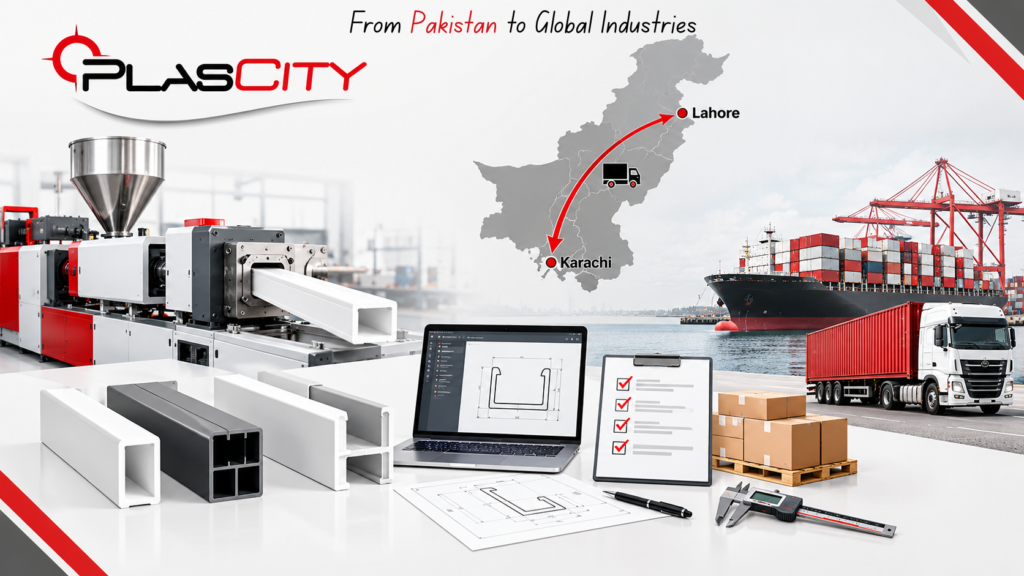
Factories in Punjab usually move containers to the ports by road or rail. Ask your manufacturer to include that leg in the quote.
In October 2026, MSC restored a weekly direct service between Karachi and major European ports via Colombo, which gives exporters another option.
Ask your forwarder for the current schedule and add a buffer. For first samples, air courier is the usual choice. Production goes by sea.
Freight is only one line in your landed cost. Duty is the other, and it moved this summer.
US Tariff on Plastic Products from Pakistan and EU Duty Checks
As of October 2026, most goods from Pakistan entering the US pay an extra 10% Section 301 duty on top of the normal duty for their HS code. That is lower than the 12.5% rate on China and Vietnam.
This duty has applied since 24 July 2026. China can also carry older duties on top for some products.
The date that counts is the day your goods enter the US. Not the invoice date, and not the day the container left Pakistan.
Tariff rules have changed several times in the past two years. Check the current rate for your HS code with your customs broker, or on the USITC and USTR websites, before you confirm a price.
For EU buyers, Pakistan has had preferential access under the GSP+ scheme. Check whether your HS code is covered and what the current status is before you order.
Build landed cost as one number: product price, freight, duty and port fees. Compare that number, not the factory price.
Now the step that protects you from all of the above. It costs little, and many buyers skip it.
Pre Shipment Inspection for Pakistan Plastic Orders: What to Check Before the Container Closes
A pre shipment inspection checks your order after production is mostly finished and before it ships, so you can reject problems while the goods are still at the factory.
Inspectors usually visit when at least 80% of the order is finished and packed. They count cartons, measure dimensions, check workmanship and packaging, and compare the goods to the approved sample.
Sampling normally follows ISO 2859 part 1, which sets how many pieces to check and how many defects are acceptable. Agree those limits before production starts, not after the inspection is booked.
For plastic profiles and parts, add your own fit test. I learned this the hard way. One of our profiles matched the customer’s drawing perfectly, and it still did not fit smoothly on their assembly line.
A small die adjustment fixed it. But the lesson stayed. A drawing does not tell you how a part behaves in real use. That is why we now ask for mating parts and test with them before mass production.
Also agree what happens when a lot fails: rework, replacement or credit. Write it down before you pay the balance. Our own checks are described on our quality control page.
So which mistakes do buyers repeat most? Here is my list.
Plastic Manufacturer Pakistan Mistakes: What OEM Buyers Get Wrong
- Choosing on price alone. Quotes only compare when material, grade and tolerances match. Recycled material can make a quote look cheaper while the part is weaker. See our guide on how to spot recycled plastic.
- Using EXW on a first order. You inherit export clearance in a country you do not know.
- Paying the tooling invoice with no ownership clause. This is the expensive one I promised at the start.
- Skipping inspection to save a small fee. The fee is small. The rejected container is not.
- Using last year’s duty rate. Check the rate on the day of entry.
- Sending only a drawing. Share the application, operating environment, annual volume and, if you can, a sample or mating part.
Questions to Ask a Plastic Manufacturer in Pakistan Before You Request a Quote
Ask these eight, and you will learn more from one email than from any directory:
- Which trade term and port are you quoting?
- Which payment terms do you offer on a first order?
- Who owns the tooling and my design, and will you sign that and an NDA in writing?
- Is any part of the tooling made by a subcontractor?
- Which material and grade is this quote for, and is it virgin?
- Can a third party inspector visit before shipment?
- Which documents and HS code come with every shipment?
- Which export markets have you shipped to, and can you share references?
FAQ: Plastic Manufacturer Pakistan and Export Orders
Can I source custom plastic parts from Pakistan for my OEM business? Yes. Work with a manufacturer that quotes a clear trade term, signs a tooling ownership clause, provides full export documents and accepts third party inspection.
What is the safest payment method for a first order? Cash in advance and letters of credit are the common choices for new relationships. A deposit with the balance against shipping documents is a common middle path.
Who should own the tooling? Whoever the written agreement says. Many OEM buyers ask to own it. Whatever the model, the clause must state when ownership passes and whether the tool can be released.
Which Incoterm should I use? FCA or FOB for most first orders, with the port or place named. Avoid EXW unless you have a local agent to handle export clearance.
How long does shipping from Pakistan take? It varies by route and season. Ask your forwarder for the current schedule and add a buffer.
Is there a US tariff on plastic products from Pakistan? As of October 2026, most goods from Pakistan pay an extra 10% Section 301 duty on top of the normal duty. Check the current rate before you order.
Will my design stay confidential? Yes. If you ask for an NDA, we sign it with you. A mould you paid for remains your property.
Request a Quote From a Plastic Manufacturer in Pakistan
If you are comparing manufacturers, send us what you have: CAD drawings, a physical sample or mating part, your application, annual volume and destination port.
We review the details and come back with technical questions before we quote. That is how we avoid surprises for you.
About PlasCity
PlasCity is a third generation, family run custom plastic extrusion and injection molding manufacturer in Ferozewala, Punjab, Pakistan. We have served OEMs and industrial manufacturers since 1978.
We run 13 extrusion lines with 600,000+ metres of profile capacity per month, and we develop dies and molds in house. We work with PVC, ABS, HDPE, PP, LDPE, LLDPE, PET, Nylon and Polycarbonate, made to customer drawings, CAD files and specifications.
Industries we serve include HVAC, refrigeration, construction, electrical, food processing, retail display, LED lighting, AHU, automobile, agriculture, furniture and medical.
Contact PlasCity
- Business: PlasCity | Custom Extrusion Plastic Profiles and Parts Manufacturer
- Address: Phase 1 Al Rehman Garden, Ferozewala, Shahdara, Punjab, Pakistan
- Phone: +92 322 1146074 and +92 331 1146064
- Website: plascityextrusion.com
- Email: info@plascityextrusion.com
- Google Business Profile: https://share.google/A3vJt8LgFViPkTJ8o
- Google Maps: https://maps.app.goo.gl/TiDUn6o4ZyPWf5Ea8