Extrusion Manufacturing | By Usama Khan, PlasCity | 9 min read
“Do you have something similar to this?”
We hear that question almost every week. After manufacturing custom plastic extrusion profiles since 1978, we’ve noticed the same misconceptions come up again and again, regardless of the industry. A customer sends us a photo of an aluminium part, a rubber seal, or an imported plastic profile they found somewhere else. They think their only option is to pick from a catalogue.
It usually isn’t.
Quick Answer
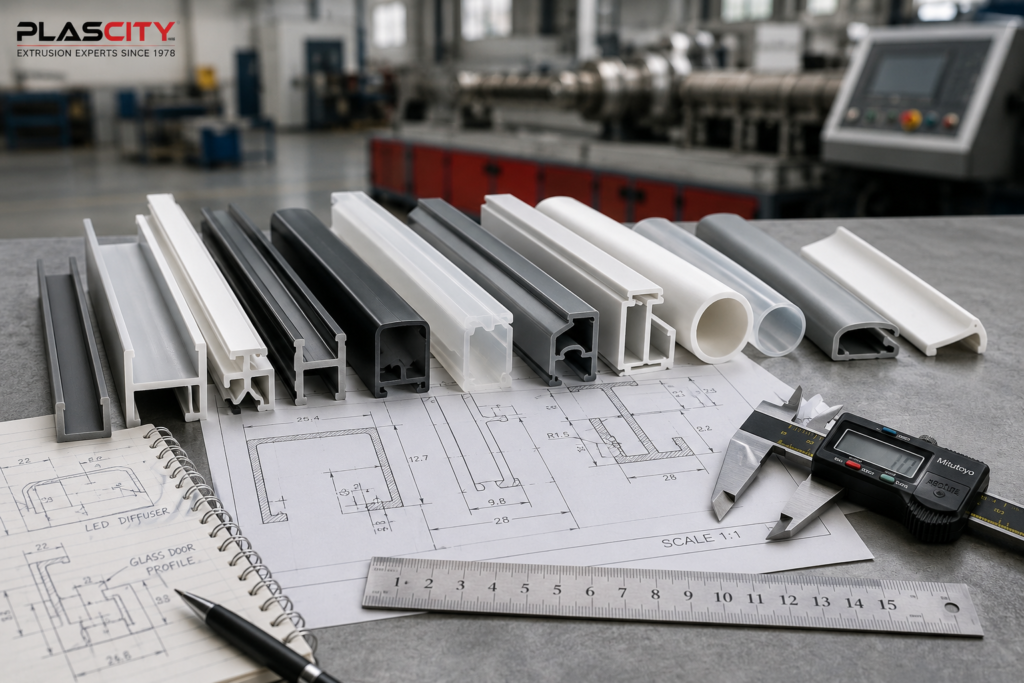
A plastic extrusion profile is a continuous plastic shape, things like channels, tubing, trims, and custom cross sections. You can buy one that already exists as a stock shape, or have one made to your exact drawing.
Most people assume stock is cheaper and custom is complicated. In our experience it’s often the opposite. A profile built for your product, from the start, usually costs less over time than forcing a stock shape to fit.
Price mostly comes down to material and volume, not the shape itself.
Not sure how the process itself works? Here’s how plastic extrusion actually works.
If you already know you want a custom plastic extrusion profile, skip ahead and send us a drawing, sample, or even a broken part. Our CAD team can usually reverse engineer the profile before tooling begins.
What You’ll Learn
| Question | Section |
|---|---|
| What counts as a profile | What Counts as a Plastic Extrusion Profile |
| Stock or custom, which one | Stock vs Custom |
| What a good material choice actually looks like | The Material Question |
| What moves the price | What Actually Drives the Price |
| What we can’t stand about how quotes are usually done | A Pet Peeve Worth Sharing |
| A real project that could have gone wrong | The LED Diffuser Story |
What Counts as a Plastic Extrusion Profile
A profile is a shape that stays the same all the way along its length.
Picture a cookie cutter. Now imagine pulling that same shape through, meter after meter, in plastic instead of dough.
| Shape type | Common use |
|---|---|
| Channels (U, C, J) | Wire management, edge protection, sliding tracks |
| Angles (L shape) | Corner protection, structural bracing |
| Tubing | Pipes, medical and food grade lines |
| Trims | Window frames, furniture edging |
| Custom cross sections | Built for one specific product |
Most people already know which of these they need. The real question is usually stock or custom.
Stock vs Custom
Here’s the misunderstanding we run into the most.
Customers think they need to find something close enough that already exists. So they send us a picture and ask if we have “something similar.”
But close enough isn’t the same as right.
A stock shape that’s almost the right fit often creates extra work later. Extra assembly steps. Awkward gaps. A part that technically works but never quite sits right.
Once we explain that a custom profile can be built for their exact product, most customers realize it actually saves money long term, not costs more. Less rework. Less wasted material. A cleaner fit the first time.
Because our CAD design, die manufacturing, and extrusion production all happen in-house, we’re able to review a design, manufacture the tooling, produce samples, and make adjustments without depending on outside toolmakers. That usually means faster development and fewer delays if a profile needs refining after the first sample.
That said, stock still has its place. If your shape is common, like a basic channel or a round tube, and you need it fast, stock is the quicker route. No tooling wait, no design back and forth.
Our real numbers, if it helps you plan:
- Custom die development: 7 to 14 days
- Typical minimum order: 2,000 meters
- Daily production capacity: 10,000 to 13,000 meters
- Largest single order we’ve completed: 58,000 meters, delivered across three batches
- We can scale to 24/7 production when a project is urgent
The Material Question
PVC is the default answer for most people. It’s familiar. It’s usually cheaper.
But familiar isn’t always right.
If your part needs to handle impact, heat, food contact, UV exposure, or flexibility, PVC might not hold up. We’ll usually point you toward ABS, polycarbonate, HDPE, PP, nylon, PET, or a flexible compound instead, depending on what the part actually has to survive.
We’ve learned that saving a few cents per meter on material often costs far more later through failures, replacements, or production downtime.
Sometimes the fix isn’t even the material. It’s the design. A small change to a profile, one nobody would notice by looking at it, can make it stronger, easier to produce, and cheaper, all without changing what it does.
What Actually Drives the Price
People assume price is about how complicated the shape looks. It usually isn’t.
Material is the biggest factor. Often more than half your cost per meter. This is exactly why two quotes for the “same” part can look completely different. One of them probably isn’t using the material you think it is.
Volume changes price per piece, not your total spend. Tooling and setup are mostly fixed. Spread that cost over 2,000 meters and it barely shows. Spread it over 200 and it dominates the price.
Tighter tolerance costs more. Sometimes relaxing a tolerance by just a few tenths of a millimeter can noticeably reduce production cost without affecting the performance of the finished product. That’s a conversation worth having before tooling begins.
None of this means the cheapest quote is wrong. It just means it’s worth asking what material and what tolerance that number is actually based on.
A Pet Peeve Worth Sharing
Something that genuinely frustrates us: suppliers who give a price before they understand what the part is actually for.
A profile isn’t just a drawing. It’s a material, a wall thickness, a tolerance, an environment it has to survive, and a volume.
We’ve had customers come to us after choosing a cheaper quote elsewhere, only to find the part warps, cracks, or doesn’t fit once it’s actually in use. Fixing that after production starts costs far more than asking the right questions before it does.
We’d rather ask five extra questions upfront than let a customer find out the hard way six weeks later.
The LED Diffuser Story
A client once sent us two designs. A simple housing, and a diffuser that would sit inside it, both meant for an LED linear light display.
On paper, it looked fine. Both parts matched the drawings.
But looking closer, we noticed the diffuser had a 5mm height at its locking point before the diffuser surface actually began. If we had built that exactly as drawn, light would have leaked out through that 5mm gap, right along the sides of the display.
The whole point of the product was to release light from the front of the diffuser. Not from the edges.
We called the client before touching the mold. Walked them through what we’d seen, and why it would look unfinished once it was lit up and mounted. They agreed immediately.
We reduced the lock height so the diffuser sits flush against the housing wall. Because we caught it before tooling, the client avoided unnecessary mold modifications, extra samples, and production delays.
No wasted mold cost. No wasted sampling time. Just a five minute conversation that caught it early.
This is the same approach we used on a refrigeration client’s glass door profiles, reviewing the application before committing to tooling, not after.
Frequently Asked Questions
Where can I find a custom plastic extrusion profiles supplier?
Look for one with in house tooling, so design changes don’t depend on a third party. Ask for a sample or a past project close to yours before you commit.
Do you supply PVC plastic extrusion profiles?
Yes, along with ABS, HDPE, PP, and several engineering plastics, depending on what the application actually needs.
Are stock plastic extrusion profiles available for sale?
Yes. Common shapes like channels and tubing don’t require new tooling. If your shape is close to a stock match, it’s usually the faster option.
How do I find a plastic profile manufacturer near me?
Distance helps with shipping, but it shouldn’t be the deciding factor. Tooling capability and material range matter more, especially since most orders ship well beyond the local area anyway.
Do you handle bulk plastic extrusion profile orders?
Yes. Our typical minimum is 2,000 meters, and pricing improves as volume goes up since tooling costs spread across more units.
How do I get a plastic extrusion profile manufacturer quote?
Send your drawing, a sample, or even a rough sketch, along with your material preference and quantity. That’s enough for a real quote, not just a rough guess.
Get a Quote on Your Plastic Extrusion Profile
Send us your drawing or a sample. We’ll review the application first, and quote second.
Phone: +92 322 1146074 / +92 331 1146064
Email: info@plascityextrusion.com
Google Business Profile: View PlasCity on Google