Before you approve any OEM plastic supplier for production, verify five things: who owns the CAD design and tooling, whether you get a physical sample before mass production, how material is chosen for your product’s real environment, what happens if a batch fails inspection, and whether the quote reflects real manufacturing cost or just a guess. Most supplier problems trace back to one of these five points being skipped or assumed instead of confirmed in writing.
Why This Checklist Exists
Search the internet for “how to choose a plastic manufacturer” and you will find the same list everywhere. Ask about lead time. Ask about certifications. Ask if they can handle your volume.
That advice is not wrong, but it is not enough. It tells you what to ask. It does not tell you what a bad answer sounds like, or what happens after you already signed the purchase order and the sample comes back wrong.
This article comes from the other side of that conversation, the manufacturer’s side, after years of sitting across the table from procurement managers who got burned once and were not going to let it happen twice. Some of what follows will not be new to you. Some of it is the part everyone else leaves out.
Who Owns the CAD Design and the Tooling?
This is the first question a sharp procurement buyer asks, and it should be the first one you ask too. Some manufacturers expect you to hand over a finished CAD design. Others, like a proper OEM plastic manufacturer, build the design themselves based on your product, your dimensions, and how the part will actually be used, then send it back to you for approval before anything is built.
The follow up question matters just as much: who pays for the die or the mold, and who owns it afterward? Ask this directly. A supplier who invests in the tooling themselves and stands behind it is telling you something about how confident they are in their own process. A supplier who wants you to pay for tooling up front and offers no ownership clarity is a conversation you need to slow down, not speed up.
See our full in house tooling and design capabilities for how this process works from CAD to finished die.
Do You Get a Sample Before Mass Production, or Just a Promise?
This is where a lot of buyers get burned, and it is the single most common gap we hear about from clients who switched to us after a bad experience elsewhere.
Here is a real story from one of our meetings. A procurement manager came to us after finalizing a different vendor first.
In that first meeting with the other vendor, everything got agreed to instantly. Yes to the design. Yes to the timeline. Yes to production. No pushback, no questions, no friction. It felt easy.
Then the vendor built the CAD design and shared it. The buyer reviewed it and asked for changes, which is completely normal at this stage. But when the sample came out, it did not match the agreed dimensions.
When the buyer asked for a revision, the vendor pushed back. They blamed the buyer for the requested changes and refused to revise the sample without restarting the entire process as a new paid job.
That buyer came to us afterward. Before agreeing to anything, they asked us the same set of pointed questions: who builds the design, who owns the tooling cost, and do we provide a sample before mass production begins.
We explained that we build and revise samples until the client approves them, and that we never start production before that approval. The tone of the meeting changed right there. That single answer marked the difference between a vendor who says yes to everything and a manufacturer who actually stands behind the process. That client has stayed our business partner for ten years now.
The lesson for you: never accept “we’ll get it right in production” as an answer. Ask specifically how many sample revisions the supplier includes, and get it confirmed before you sign anything.
Is the Material Actually Right for Your Product, or Just Familiar?
A lot of buyers default to PVC because they already know it, or because it looks cheapest on paper. But the material question is not about familiarity, it is about what your product actually has to survive. Heat, UV exposure, chemical contact, flexibility needs, and food or medical contact all change which material makes sense.
If you’re unsure which material fits your product’s environment, our material guide breaks down PVC, ABS, HDPE, PP, and other options by use case.”
A supplier worth working with asks where the product will be used and what conditions it needs to survive, before recommending a material, not after.
If a material recommendation raises the price from what you expected, that is not automatically a red flag. Sometimes the cheaper material genuinely cannot survive your product’s real environment, and a supplier who explains that tradeoff clearly is doing their job. Watch out instead for a supplier who never asks about your environment at all.
Is the Quote Based on Real Manufacturing Cost, or a Guess?
This next story matters more today than it would have a few years ago, because of how easy it has become to generate a quick estimate using AI tools.
A client based in the United States, who could not visit our facility in Pakistan, sent us a design generated using an AI image tool. It looked like a real product, but it had no confirmed dimensions or weight.
When we asked for the missing details so we could calculate an accurate rate, the client suggested we simply put the image into an AI tool ourselves and let it generate the dimensions and weight for us.
We explained, respectfully, that pricing is too sensitive to hand over to a guess. Once we quote a client, we do not revise the number later, so it has to be right the first time. That means basing it on real experience and real production numbers, not an estimate from a tool that has never actually manufactured anything.
We worked out the real numbers ourselves and quoted a fair mid range rate. Two days later, the client came back saying a different manufacturer, using an AI estimate, had quoted a price nearly half of ours. The client suggested we simply did not know how to use AI to stay competitive.
We explained plainly that our number reflected real material and production cost, not guesswork, and that the other quote actually sat below the raw material cost alone.
A week later, the same client messaged us again. The other manufacturer’s actual mold sample came back at almost the exact price we had quoted from the start. The client apologized, dropped the other vendor, and has worked with us since.
Their own words afterward summed it up well: AI is useful, but some decisions still need real expertise and real experience behind them, not a quick estimate.
The takeaway for you as a buyer: if two quotes for the same part are dramatically far apart, do not assume you found a bargain. Ask what the lower quote is actually based on. A number with no real production reasoning behind it is not a discount, it is a risk you are inheriting later.
What Happens If a Batch Fails Inspection?
Almost no buyer asks this up front, and almost no supplier volunteers the answer, which is exactly why it belongs on this checklist.
Before you approve a supplier, ask directly what happens if a completed batch fails inspection. Do they rework it, scrap it, or ship it anyway and hope you do not notice?
A manufacturer with real quality control gives you a clear, specific answer involving dimensional checks, wall thickness checks, and visual inspection at multiple stages, not a vague reassurance that “quality is our priority.”
A Short Pilot Order Checklist Before You Commit to Full Volume
Use this before you sign off on full production, not after:
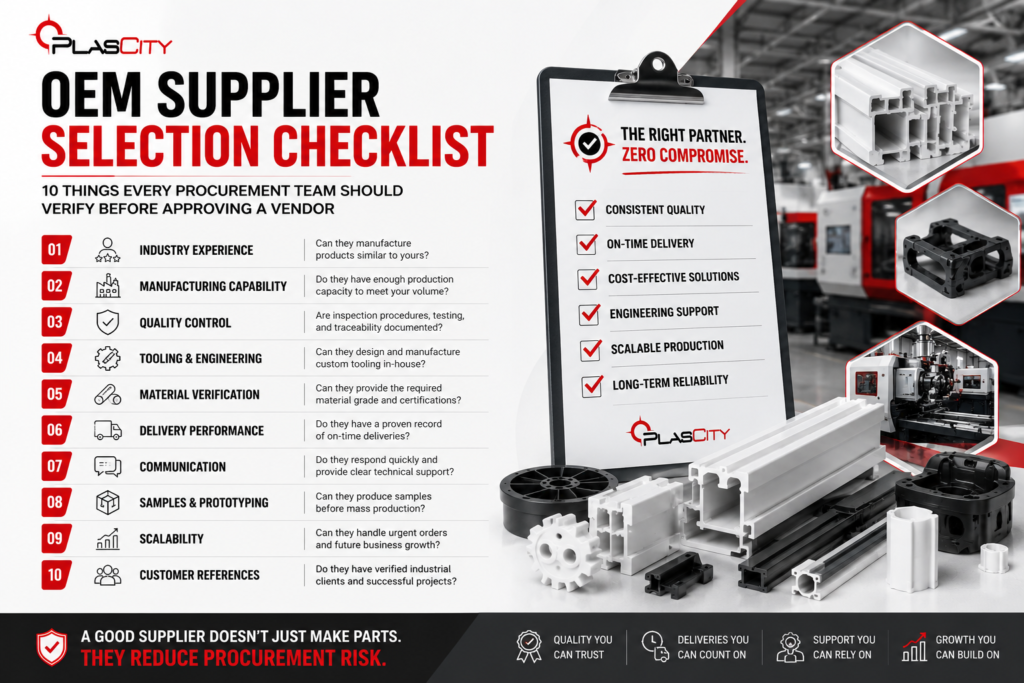
- Confirm in writing who owns the CAD design and who pays for tooling
- Confirm the number of sample revisions included before mass production
- Ask what environment your product needs to survive, and see if the supplier asks you the same question first
- Get a clear cost breakdown, not just a final number
- Ask directly what happens if a batch fails inspection
- Request a small pilot or trial batch before committing to full volume, especially with a new supplier
Key Takeaways
- The strongest suppliers ask you questions before quoting a price, not after
- Sample approval before mass production is not optional, it is the single biggest protection you have as a buyer
- A dramatically lower quote usually means missing cost reasoning, not a better deal
- Material choice should be based on your product’s real environment, not habit or lowest price
- Ask what happens when something goes wrong before you find out the hard way
Related Reading
Learn more about how the process behind these parts actually works in our guide, What Is Plastic Extrusion? A Guide From a Real Plastic Extrusion Manufacturer. You can also explore our injection molding capabilities, our quality control process, and the industries we serve.
Work With a Manufacturer Who Answers These Questions Before You Ask
PlasCity has been manufacturing custom plastic profiles and OEM components since 1978, with in house die and mold development, full sample approval before production, and no minimum order requirement that shuts out growing buyers. Send us your CAD file, drawing, or even a rough sketch, and we will walk you through material, tooling, and sampling before you commit to anything.
Browse our range of custom plastic profiles and OEM components to see what we’ve built for other buyers.
Contact PlasCity Phone: +92 322 1146074 / +92 331 1146064
Email: plascity1@gmail.com , info@plascityextrusion.com
Address: Phase 1 Al Rehman Garden, Ferozewala, Shahdara, Punjab, Pakistan
Website: plascityextrusion.com