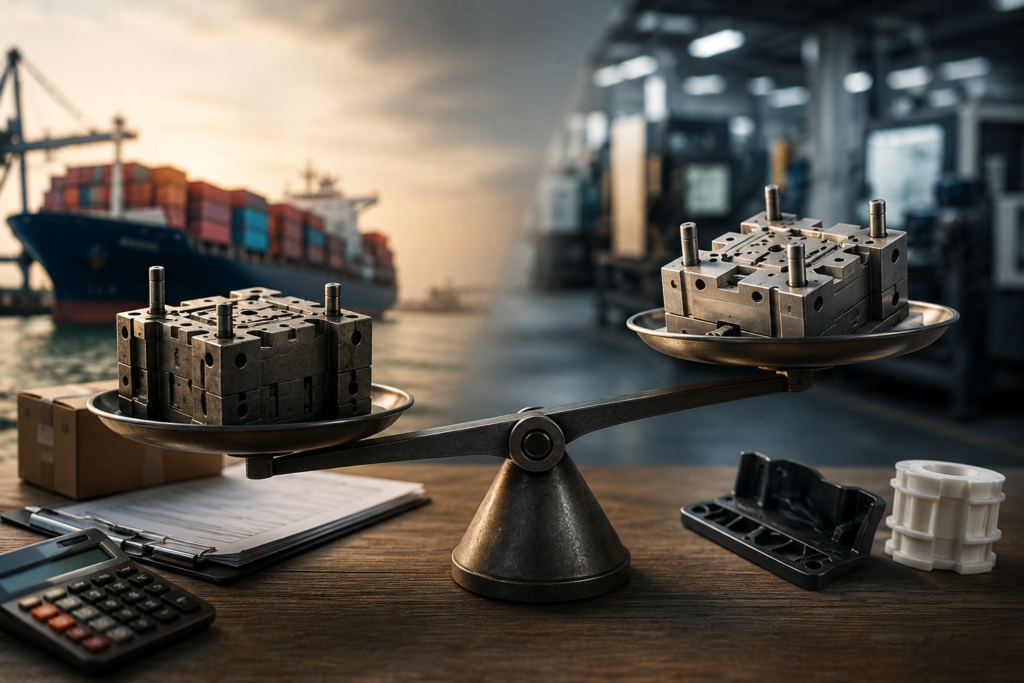
The Short Answer
Two quotes land on your desk. One is much cheaper. It is tempting to pick it and move on. This is usually the moment where the real cost of the project actually gets decided, long before the first part is molded.
The cheapest injection molding quote is rarely the cheapest option once your parts actually arrive. The real cost includes shipping time, customs clearance, currency exposure, and the price of fixing a mold after it has already left the factory. A local manufacturer with an in-house die shop removes most of these costs before they even start. This article shows the numbers behind that claim, and what to check before you sign off on any quote.
What You’ll Learn
| Question | Where to find it |
|---|---|
| Why does the lowest quote often cost more later | The Hidden Cost section |
| How much extra time does importing tooling add | Lead Time section |
| What changes for buyers in Pakistan, Asia, the Middle East and Europe | Regional section |
| What mistakes do procurement teams repeat | Common Mistakes section |
| What to ask before requesting a quote | Questions section |
The Pain Point: Why the Lowest Quote Feels Like the Safe Choice
Procurement teams are measured on cost savings. A quote that is 40 to 50 percent cheaper looks like an easy win on paper. It is hard to say no to a number that good.
But a mold quote is not the full picture. It only covers the steel and the machining. It does not cover what happens after the mold ships.
This is where most of the real cost hides. And it is rarely visible until the parts are already late or the first samples fail.
What the Lowest Quote Doesn’t Show You
Total cost is bigger than tooling price. Industry cost models built for offshore sourcing decisions point to five categories buyers usually miss: tariffs and duties specific to your product code and country of origin, ocean freight and customs brokerage, the working capital tied up while stock sits in transit, the cost of a delayed shipment or a congested port, and the cost of fixing quality problems across a time zone gap.
None of these show up on the first quote. They show up weeks later, as a delay, an invoice, or a rejected batch.
Injection molding has its own specific cost levers that make this worse than a simple price comparison. Cavity count, steel grade, and cycle time all shift the real price of a mold in ways a single quoted number does not explain. A single-cavity aluminum mold and a four-cavity hardened steel mold can look like the same line item on a spreadsheet and behave completely differently in production. A lower quote often means a softer steel grade or fewer cavities, which is fine for a short run and expensive for a long one.
This pattern shows up often enough in the industry to be worth naming directly.
One tooling comparison study found a pattern that repeats often enough to be a warning sign, not an exception. A tool that looked 50 to 60 percent cheaper offshore ended up costing more overall once revisions, delays, and rework were added to the original invoice price.
This does not mean overseas tooling is always the wrong choice. It means the sticker price is not the decision. The total cost is.
A Real PlasCity Example:
We saw this firsthand with an automotive component used in a car window shade system. A client approached us for the cost of two injection molded plastic components: a slider and a stopper used on the railing surface of the window shade.
We proposed two molds for the two components. Our tooling cost was higher because the molds were designed to produce 10 pieces in a single press cycle. The client chose a cheaper option and imported the molds instead.
The imported molds were cheaper upfront, but they could produce only 4 pieces per press cycle.
The difference became clear when production started. The finished product from the imported mold cost approximately PKR 1.30 more per piece than the price we had originally quoted.
The client then asked us to manufacture the product using his imported molds at the same product price we had previously offered. We explained that this was not possible because our original product price was based on the production efficiency of the 10-cavity molds we had proposed.
For example, producing 1,000 pieces with our mold would require approximately:
1,000 ÷ 10 = 100 press cycles
The imported 4-cavity mold would require:
1,000 ÷ 4 = 250 press cycles
That means 150 additional press cycles for the same 1,000 pieces.
Those extra cycles increase machine time, electricity consumption, manpower, quality control, and other production costs. The client had saved money on the mold but ended up paying more for every part.
This is an important point in injection molding: sometimes the mold with the higher upfront cost is designed specifically to reduce the cost of the finished product.
The mold was not simply a tooling expense. It was a one-time investment that affected the cost of every part produced afterward.
Lead Time: The Number Buyers Underestimate
Price gets most of the attention. Time is usually the bigger risk.
Shipping tooling or parts from overseas typically adds four to twelve extra weeks to a project, on top of the time needed to build, test, and approve the mold itself. That is before the mold even reaches your production line.
One direct comparison found domestic tooling delivered in six to eight weeks, while an equivalent overseas mold took ten to fourteen weeks. A cheaper mold that arrives two months later is not automatically the better deal.
For a procurement manager working against a launch date, that gap is not a small detail. It is the difference between hitting a deadline and explaining a delay to leadership.
What This Means for Buyers in Pakistan, Asia, the Middle East and Europe
If you are sourcing from outside Pakistan, this cost structure applies to you directly. Every extra week in transit is a week your product is not on shelves or your production line is idle.
Importing tooling or parts also usually means Letter of Credit paperwork, customs clearance timelines, and duty exposure that changes with policy. None of that shows up in the unit price you compare on a spreadsheet.
A local manufacturer removes these steps. Tooling built in Pakistan does not wait on a ship. It does not wait on customs. A revision request is a phone call and a factory visit, not a new shipment. This is also the practical reason so many buyers now search for an injection molding company near me rather than accepting the first offshore quote they receive.
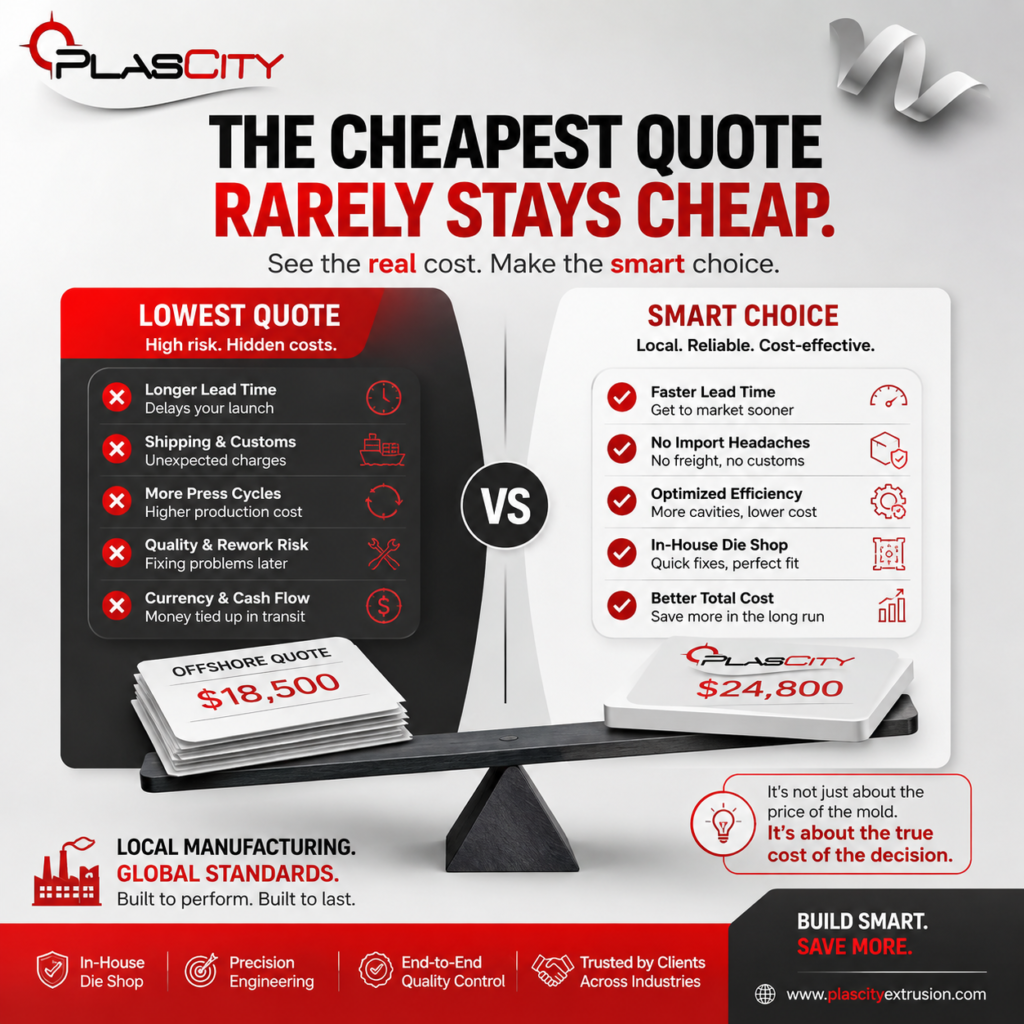
This is also why in-house die and mold development matters more than buyers usually realize. If your manufacturer designs and builds the mold on-site, a fit issue can be corrected in days, not in another six to twelve week shipping cycle. It also means faster dimensional control and accurate sampling before mass production starts, since the same team that designed the tool is standing next to the machine running it.
For buyers outside Pakistan specifically, this also reduces currency and shipping risk. A quote in a stable local process, with direct factory access, removes a layer of exchange rate and freight uncertainty that an offshore quote usually carries quietly inside its price.
Local Manufacturing vs. Imported Tooling: A Quick Comparison
| Factor | Imported Tooling | Local Manufacturer (Pakistan) |
| Typical added lead time | 4 to 12 extra weeks in transit | No ocean freight wait |
| Mold revision after first sample | New shipment cycle required | Days, through direct factory access |
| Paperwork | LC processing, customs clearance | Not required |
| Duty and tariff exposure | Yes, varies by product code and country | Not applicable |
| Communication | Time zone gap, indirect | Direct, same time zone |
Common Mistakes Procurement Teams Make
Comparing tooling price without comparing total landed cost. The fix is simple. Ask every supplier for a full cost breakdown, not just the mold price. Include freight, duties, and expected revision costs before you compare numbers.
Sending an incomplete drawing to save time. A mold is cut directly from your file. If the file is not final, the mold is built to the wrong shape, and fixing it after the steel is cut costs far more than fixing it before.
Choosing a supplier before asking who owns the tooling. Some suppliers hold the mold as leverage for future orders. Confirm ownership terms in writing before production starts.
Skipping the sample stage to save a few days. A sample catches fit and function problems while they are still cheap to fix. Skipping it usually costs more time later, not less.
Questions to Ask Before You Request a Quote
- Does the quote include tooling only, or tooling plus first samples and revisions
- What is the total lead time from approval to parts in hand, including shipping if applicable
- Who owns the mold once it is paid for
- What steel or material is being used, and is it matched to your production volume
- How are revisions handled if the first sample does not fit
A supplier who answers these clearly, before you ask twice, is usually the supplier worth working with. For a fuller evaluation before you commit to any supplier, our OEM plastic supplier checklist covers the questions that matter beyond tooling alone.
Why PlasCity
PlasCity has been manufacturing custom plastic parts and profiles in Pakistan since 1978, across three generations of the same family business. Injection molding and precision extrusion are both handled in-house, including die and mold design.
Because tooling is built on-site, sample revisions do not require a new shipment or a new customs cycle. A fit issue can be corrected in days, not in another shipping cycle.
PlasCity works across a wide range of materials, including PVC, ABS, HDPE, PP, LDPE, LLDPE, PET, Nylon, and Polycarbonate, matched to the part’s real operating conditions rather than the cheapest material by default. The facility follows a documented quality process and is food grade certified, with multi-stage inspection on every production run.
For buyers whose project also involves custom profiles rather than only molded parts, the same in-house team and the same total cost logic applies. See our guide on choosing a plastic extrusion profile supplier for that side of the process.
The full list of what this means for a buyer, from no die costing charges to unlimited revisions before sample approval, is on our Services page.
Frequently Asked Questions
Is a local injection molding manufacturer in Pakistan cheaper than importing?
The mold itself may not always be the cheaper number. But once you add shipping delay, customs paperwork, and the cost of correcting a mold after it has shipped, local manufacturing usually wins on total cost, and it almost always wins on speed.
How long does it take to get an injection molding quote from PlasCity?
Share your drawing, material requirement, and expected volume, and PlasCity responds with a full breakdown covering tooling, samples, and production, not just a single price.
Can PlasCity handle small and mid-volume custom injection molded parts?
Yes. Tooling material and cavity count are matched to your actual order size, whether that is a short prototype run or an ongoing production volume, rather than defaulting to one standard mold setup for every order.
Request a Quote
If you are comparing plastic injection molding services quote by quote, ask for the same breakdown from every supplier: tooling, samples, revisions, and lead time, not just a single number. Send your CAD drawing, material requirement, and target volume, and PlasCity will provide a full breakdown covering tooling, samples, and production, so you can compare total cost, not just a number on a page.
Contact PlasCity
Phone: +92 322 1146074, +92 331 1146064
Email: info@plascityextrusion.com, plascity1@gmail.com
Address: Phase 1 Al Rehman Garden, Ferozewala, Shahdara, Punjab, Pakistan
Visit plascityextrusion.com | Injection Molding Services | Google Business Profile | Google Maps