A custom plastic extrusion die usually costs between $1,000 and $15,000. Very complex dies can cost more.
Simple solid profiles sit at the low end. Hollow profiles and two material profiles sit at the high end.
The steel used in the die is one of the biggest reasons the same die can carry different prices.
A new die takes about 2 to 12 weeks at most factories. At PlasCity, a new die is often ready in around 10 days.
Paying for a die does not always mean you own it. Only a written agreement does.
But the die price is not the number that surprises buyers most. The costs around the die do. We will find them in a minute.
What You Will Learn
| Topic | What you will know |
|---|---|
| Die price | Real price ranges by profile type |
| Die steel | Steel types, their features, and how each changes cost |
| Tooling cost | What should be on a die quote, and what is often missing |
| Lead time | How long a new die takes, and why it varies |
| Ownership | Why paying is not the same as owning |
| Changes | What happens if the profile needs a fix |
| Savings | How to spend less without losing quality |
What Does an Extrusion Die Actually Do?
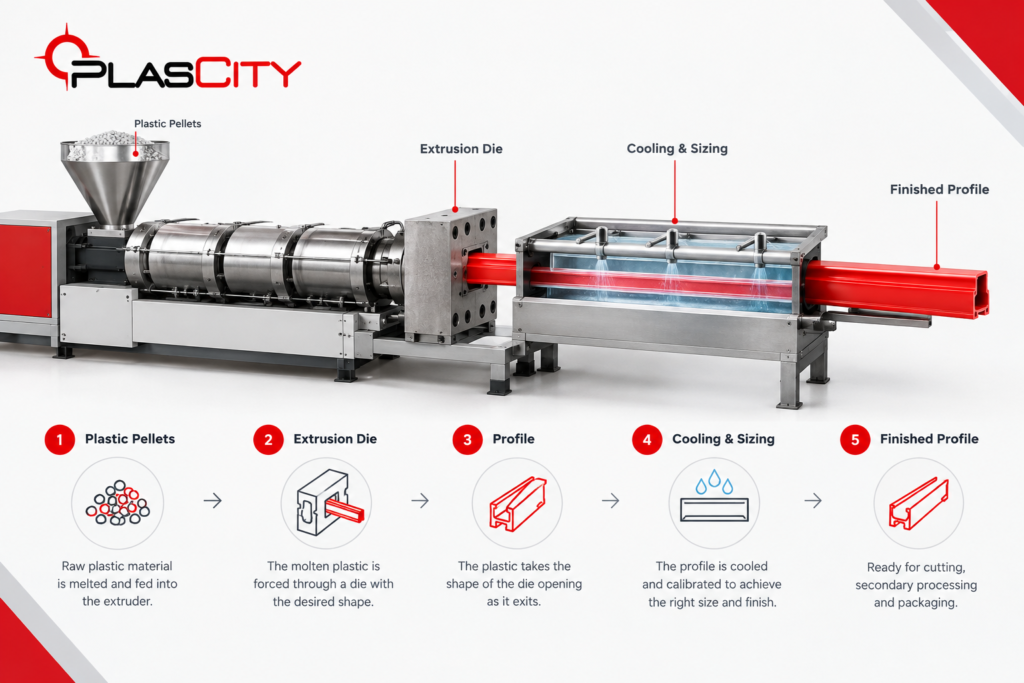
A die is a steel tool with a hole shaped like your profile. Hot plastic is pushed through the hole. The plastic comes out in the shape you need.
One die can make the same profile again and again, for years. Many dies last 5 to 15 years or more with good care.
Want the full process? Read our guide on how plastic extrusion works.
How Much Does a Plastic Extrusion Die Cost?
The prices below are global ranges from published industry sources, in US dollars. Your real price depends on your drawing.
| Profile type | Typical die cost | Why |
|---|---|---|
| Simple solid (strip, bar, flat channel) | About $1,000 to $5,000 | One shape, no empty spaces inside |
| Hollow (tube, box section, several chambers) | About $5,000 to $15,000 | The die needs inner cores and supports |
| Two material (coextruded) | Roughly 20% to 50% more | Extra flow channels for the second material |
| Very complex or very large | Above $15,000 | Some sources report over $20,000 |
Injection molds for similar work usually cost much more. Extrusion tooling is often 5 to 20 times cheaper. That is one reason long parts suit extrusion better than injection molding.
Buying a molded part instead? Read why total cost beats the cheapest quote in injection molding.
We do not print our own die prices here. Every profile is different. Send your drawing and we will cost it.
So what pushes your die to the top or bottom of the range?
What Makes a Custom Extrusion Die Price Go Up?
Six things move the price most:
- Shape. Complex shapes cost more. A profile that looks simple on paper can still be hard to run steadily.
- Hollow spaces. Every empty chamber needs its own core inside the die.
- Size. A bigger profile needs a bigger die.
- Steel grade. Harder or more corrosion resistant steel costs more to buy, more to cut and often needs plating. See the steel section below.
- Tight tolerances. More machining and polishing means more hours.
- Two materials. A second material adds a second flow path.
Steel deserves its own section. It is the main reason the same die can carry two very different prices.
Which Steel Is Used for Extrusion Dies? Steel Types, Features and Cost
Workshop people often call it iron. The correct word is steel. The steel your die is made from can change its price more than most buyers expect.
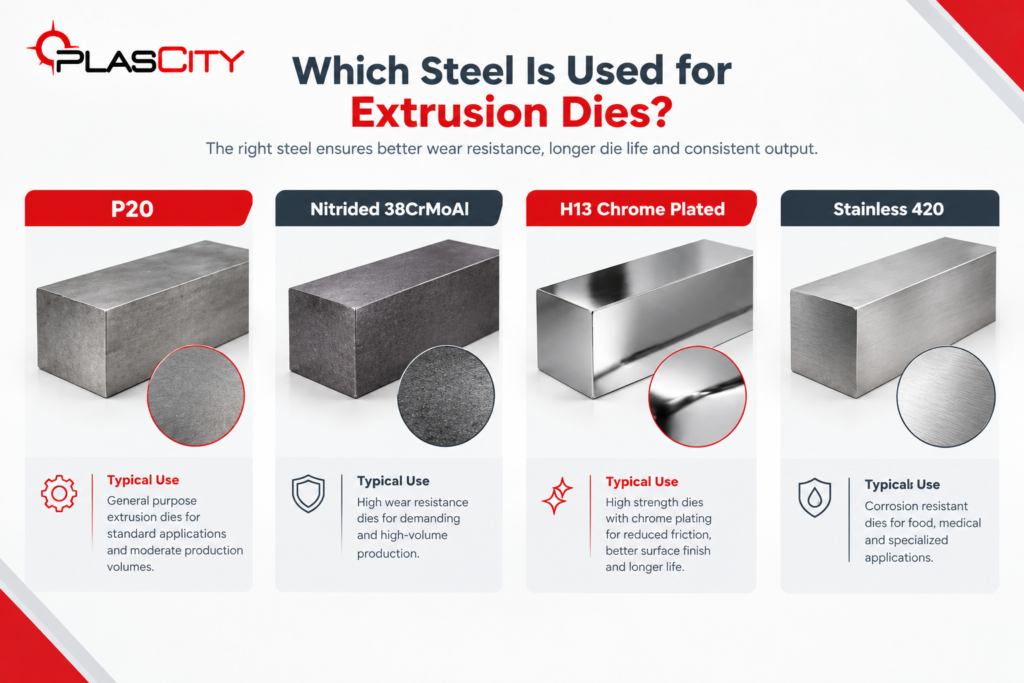
Short answer: most plastic extrusion dies use one of four steel types. They are P20 pre hardened steel, nitrided 38CrMoAl, hard chrome plated H13, and stainless 420. Cost roughly rises in that order. Plating, size and polish can shift the order.
Harder or more corrosion resistant steel lasts longer. It also costs more to buy, more to cut and often needs extra treatment.
The four main die steel types
| Steel type | Also called | Main features | Best used for | Relative cost |
|---|---|---|---|---|
| P20 | 1.2311, 40CrMnMo7 | Comes pre hardened and ready to machine without heat treatment. It is easy to machine but wears poorly. | Soft, clean plastics and shorter runs | Lowest |
| Nitrided 38CrMoAl | Nitrided steel | The standard choice for PVC and WPC dies. Gas nitriding gives a surface hardness of HV 900 to 1,100, about 0.3 to 0.5 mm deep, and it is cost effective for standard volumes. | Everyday PVC production | Low to medium |
| H13 with hard chrome plating | 4Cr5MoSiV1, 1.2344 | Preferred for heavily filled or abrasive compounds and acidic melt gases. The chrome layer, followed by polishing, extends die life by 30% to 50% over nitrided steel alone. | Abrasive compounds, PVC foam, high volume runs | Medium to high |
| Stainless 420 | S136, 1.2083 | A martensitic stainless steel with about 13.6% chromium that reaches HRC 50 to 52 after heat treatment and holds a mirror polish. For PVC dies, the 16% chromium grade is preferred. | Corrosive PVC, clear profiles, die lips and flow channels | Highest |
Why the same die can have two different prices
Three things change with the steel:
- The steel itself. For a sense of scale, one extruder screw maker says a stainless grade costs about twice as much as common 4140 alloy steel and is harder to machine.
- Machining and heat treatment. Harder steel takes longer to cut. In mold making, H13 costs 25% to 40% more to machine and heat treat than P20.
- Surface treatment. Nitriding, chrome plating and polishing are extra steps. The polish on the exit lips matters as much as the steel grade. A mirror finish gives smoother profiles and lowers the risk of scoring.
So a cheaper quote is not always a better deal. A die in the wrong steel wears out early, and a stainless die on an easy job wastes money.
Which steel suits which plastic?
| Plastic or job | Steel that usually fits | Why |
|---|---|---|
| Clean rigid PVC, normal volume | Nitrided 38CrMoAl, often with plated flow channels | PVC dies need corrosion resistant, chrome plated channels. |
| PVC foam or corrosive melt | Hard chrome plated H13, or stainless in the channels and lips | Foaming agents release corrosive gases that attack unprotected steel. |
| Filled or abrasive compounds (calcium carbonate, wood fiber, glass fiber) | Nitrided or chrome plated harder steel | Filled compounds are more abrasive and need harder die steel. |
| Polycarbonate and other high temperature plastics | Hardened steels | They increase die cost significantly. |
| Clear or glossy profiles | Stainless 420 with mirror polish | S136 (420 stainless) holds a mirror polish and suits optical parts. |
| PP, PE, HDPE | Often a lower cost steel is enough | These are less corrosive than PVC. Confirm with your manufacturer for your compound. |
One more case. In hollow profiles, the gaps around partitions can be too thin for chrome plating. In those dies, special corrosion resistant steel is used instead.
Three questions to ask before you approve a die quote
- Which steel will my die be made from, and why?
- Is it nitrided, chrome plated or stainless, and what does that treatment add to the price?
- How many meters should this die run before it needs repair?
We explain the steel choice on every die quote at PlasCity. See which plastics we work with in our materials guide.
Steel is one piece of the tooling bill. Now, what else sits around the die?
What Is Included in Plastic Extrusion Tooling Cost?
Two quotes can show the same die price and still be far apart. One may include everything. The other may leave out the parts that hurt later.
Ask if each of these is included:
| Item | Why it matters |
|---|---|
| Die design | Your profile must be turned into a working die drawing |
| Steel and surface treatment | Grade, nitriding, plating and polish change both price and die life. Ask for them in writing. |
| Trial runs | Die cost often includes trial production and adjustment. Ask how many rounds are covered |
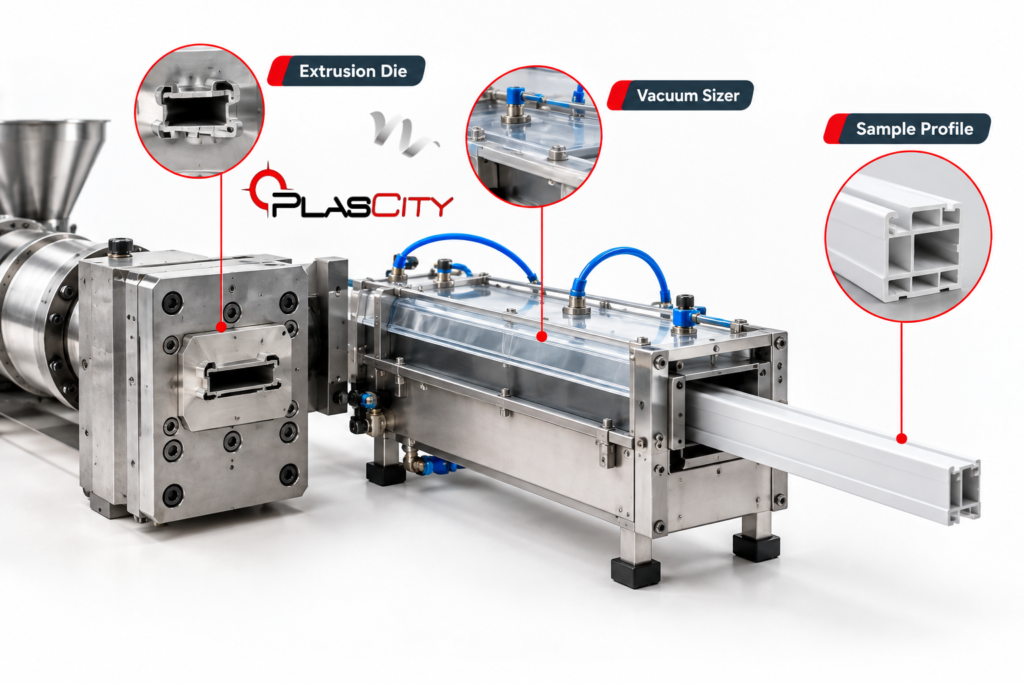
| Vacuum sizer | A sizer is made for each custom profile. It sets the final size during cooling and keeps every meter the same. |
| Revisions | Sometimes the first sample needs a small fix |
| Sample approval | A written sign off before mass production |
| Wear and repair | Who pays when the die needs work later |
The sizer is the one buyers miss most. It can look like a big extra cost at first, but it protects your size on every run.
At PlasCity, we do not charge for die costing. You get the estimate free.
A cheap die quote with no sizer and one trial round is not cheap. It just moves the bill to later. Cheap quotes can also hide cheap material. Learn how to spot recycled plastic before it wrecks your product.
Extrusion Die Lead Time: How Long Does It Take?
A simple die takes about 2 to 4 weeks. A complex hollow die can take 6 to 12 weeks.
Some manufacturers are faster. One US extruder says it can make a die in as little as two weeks.
At PlasCity, a new die is often ready in around 10 days. We design and make dies in our own facility, so we do not wait for an outside machine shop.
Die making is not the whole timeline. Trial runs and sample approval come after it.
Fast is good. But there is a bigger question than speed. Once the die is finished, whose is it?
Who Owns the Extrusion Die After You Pay?
Not always you.
Tooling ownership is a contract term, not a default. Paying for tooling and owning it are two different things unless your contract says otherwise.
Some manufacturers spread the tooling fee into the price of each part. In that case the buyer may never own the tool, even after years of orders.
Ownership and possession are also different. A die can stay in the factory and still belong to you.
Get these five answers in writing before any steel is cut:
- Who holds legal title to the die once you pay?
- Where is the die kept, and who is responsible if it is damaged?
- Can you move the die to another manufacturer?
- Who owns the die drawings?
- What happens to the die if you stop ordering?
Ask for this in writing. Any good manufacturer should be happy to give it.
One more thing. A die is tuned for one line, one material and one cooling setup. Moving it to another factory may need changes.
Which brings us to changes.
Extrusion Die Modification Cost: What If the Profile Needs a Change?
Early in our work, we made a profile that matched the customer’s drawing perfectly. It still did not fit smoothly on their assembly line.
A small die adjustment fixed it. But it taught us a lesson.
Now we ask how the profile will be used before we build the die. We ask about assembly, operating conditions, volume and critical fits. We also ask for the mating parts, so we can test in real conditions before mass production.
Changing an existing die usually costs much less than making a new one. The steel is already there.
Here is a simple rule. It is easy to remove steel from a die. It is hard to add steel back.
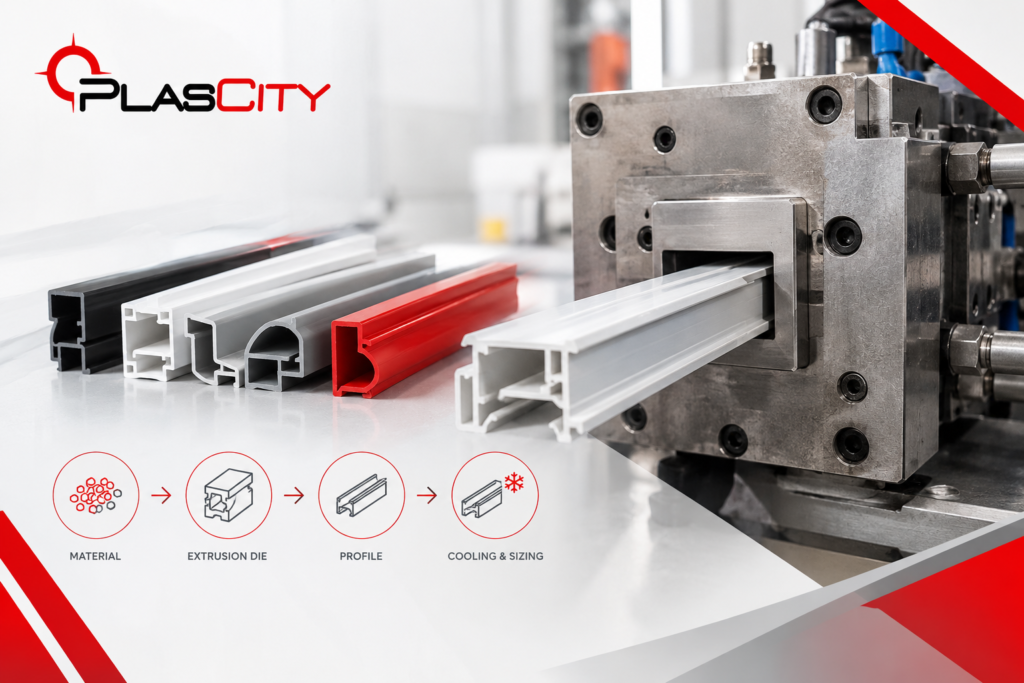
So a good die is designed to leave room for small changes. Die design is never final until the die is tested, and some margin is always left on the dimensions so changes can be made. Ask your manufacturer about this before approving the design.
A Real Example: Refrigeration Profiles
A refrigeration equipment maker was buying imported PVC profiles for glass doors and wire shelves. Quality was not consistent.
We reviewed the application and tolerances before quoting. We then suggested die design changes that cut material use and improved fit.
New tooling was ready in about two weeks. We ran trial samples with full size and fit checks.
The customer asked for one fit adjustment. We revised the die quickly, then moved to production. The order shipped on schedule, and the customer placed repeat orders.
See more of our work for refrigeration and other industries.
How Can You Lower Plastic Extrusion Tooling Cost?
You do not have to accept the first number. Try these:
- Ask if a die already exists. Some manufacturers keep stock dies you can use without paying for new tooling.
- Simplify the shape. Fewer chambers and even wall thickness make dies cheaper and easier to run.
- Match the steel to the job. Do not pay for stainless when a nitrided die will do. Do not save on steel when your compound is abrasive.
- Share the application early. A profile for outdoor use needs different material and steel than one used indoors.
- Let the die maker reduce material. In the refrigeration job, one design change cut material use on every meter.
- Order with volume in mind. The die cost is spread over every meter you buy.
Here is a simple example, for illustration only:
| Die cost | Meters made | Die cost per meter |
|---|---|---|
| $5,000 | 3,000 | About $1.67 |
| $5,000 | 300,000 | About $0.017 |
Same die. Very different cost per meter. This is why bulk buyers pay much less for tooling on each meter than small buyers do.
Six Die Mistakes That Cost Buyers Money
- Picking the lowest die price without checking what is included.
- Never asking who owns the die.
- Sending only a drawing and not the application.
- Skipping the sample test with mating parts.
- Approving the die before thinking about future volume.
- Comparing die prices without comparing the steel.
Each one is easy to avoid. Each one is expensive if you miss it.
Frequently Asked Questions
How much does a plastic extrusion die cost?
Most custom dies cost between $1,000 and $15,000. Simple solid profiles are cheaper. Hollow and two material profiles cost more.
What steel is used for plastic extrusion dies?
Most dies use P20 pre hardened steel, nitrided 38CrMoAl, hard chrome plated H13, or stainless 420. The right one depends on your plastic, filler and run length.
Why do two quotes for the same die have different prices?
Often the steel and surface treatment differ. Harder or stainless steel costs more, and plating and polishing add steps. Also check whether the sizer and trial runs are included.
How long does it take to make an extrusion die?
Most factories take 2 to 12 weeks, depending on complexity. PlasCity often makes a new die in around 10 days.
Who owns the extrusion die?
It depends on your agreement. Paying the tooling fee does not always transfer ownership, so get it in writing.
How much does it cost to modify an extrusion die?
Usually much less than a new die, because the steel is already made. The exact cost depends on the change.
Can I move my die to another manufacturer?
Yes, if you own it and the agreement allows it. The new manufacturer may need to adjust it for their line.
How long does an extrusion die last?
Often 5 to 15 years or more, depending on the material, the steel and how well it is maintained.
Get Your Die Costed
Send us your drawing or CAD file. A physical sample also works. Tell us where the profile will be used and how many meters you need per year.
We will cost the die, explain what steel and treatment it needs, and tell you how long it will take. Request a die quote.
See how we work in our manufacturing process and quality checks.
About PlasCity
PlasCity is a third generation, family run custom plastic extrusion manufacturer. We have served OEMs and industrial manufacturers since 1978.
We run 13 extrusion lines, make dies in house, and produce about 600,000 meters of profile each month. We work with PVC, ABS, HDPE, PP and other engineering plastics.
PlasCity, Custom Plastic Profiles and Parts Manufacturer
Phase 1 Al Rehman Garden, Ferozewala, Shahdara, Punjab, Pakistan
Phone: +92 322 1146074 and +92 331 1146064
Email: info@plascityextrusion.com
Google Business Profile: https://share.google/A3vJt8LgFViPkTJ8o
Map: https://maps.app.goo.gl/TiDUn6o4ZyPWf5Ea8