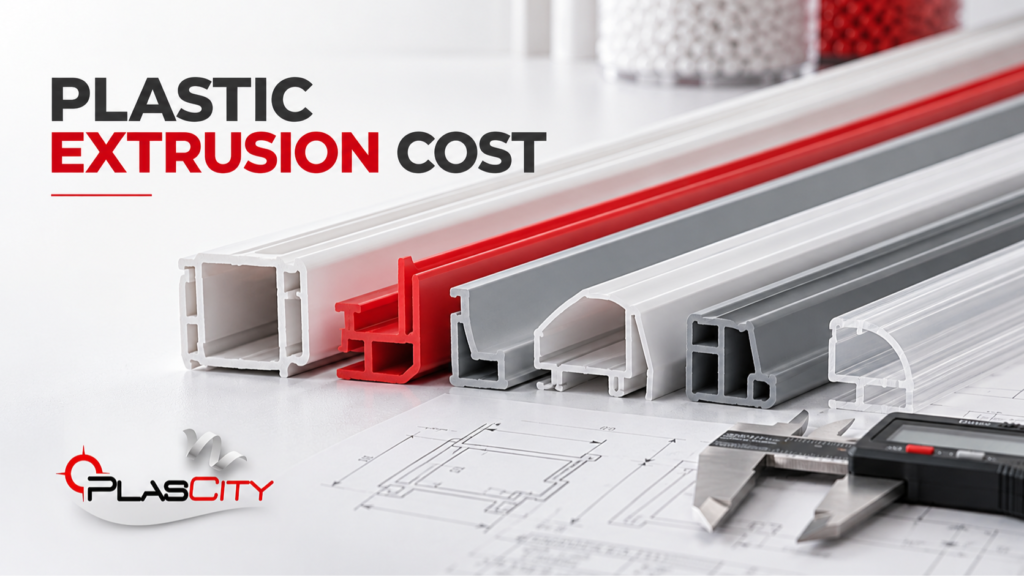
Short answer: Custom plastic extrusion cost per metre is built from material weight, scrap, line time and finishing, plus a share of the die cost. Material is usually the largest part, so weight per metre matters most. This guide shows the formula and a worked example, so you can check any quote.
Every week a buyer asks us for “the price per metre” of a custom profile. It sounds like a simple number.
But a custom profile has no catalogue rate. The price per metre is the result of a sum, and once you see the sum, you can check any quote yourself.
PlasCity is a third generation, family run custom plastic profile manufacturer in Ferozewala, Pakistan. We have served OEMs and industrial manufacturers since 1978.
This guide covers the price of each metre. It does not cover die prices, so for those read our plastic extrusion die cost guide.
One number decides more of your price than any other. We will get to it in a minute.
What You’ll Learn
| Section | What you get |
|---|---|
| The formula | The parts of a per metre price |
| Weight per metre | How to work out grams per metre yourself |
| Price drivers | What moves each part up or down |
| Quote check | Three lines that must match before you compare |
| Resin movement | Why every quote has a validity date |
| Our method | How PlasCity builds a quote |
The Formula Behind Every Plastic Extrusion Quote
Here is the sum in plain text:
Price per metre = (material per metre ÷ yield) + die cost per metre + line time per metre + finishing per metre + overheads and margin
Each part has a plain meaning:
- Material per metre is weight per metre × resin price per kg. Resin is the plastic granule the line melts.
- Yield is the share of material that becomes good product. A 95% yield means 5% is scrap.
- Die cost per metre is the die cost ÷ the total metres made. A die is the steel tool that shapes the plastic.
- Line time per metre is the hourly cost of the line ÷ the metres it makes in that hour.
- Finishing covers cutting to length, punching, printing and packing.
DFMA, a US cost modelling firm, estimates that material is 40% to 70% of the total cost of an extruded profile. That is why we start with weight.
Scrap matters more than most buyers expect. If 5% of the material is lost, your material cost per good metre rises by about 5.3%. At 10% scrap, it rises by about 11%.
Weight Per Metre: The First Number to Ask For
Weight per metre sets the biggest part of your price. And you can work it out in one line.
Grams per metre = cross section area in mm² × density in g/cm³
It works because a profile one metre long with an area of 200 mm² holds 200 cm³ of plastic. Multiply by the density and you have the weight.
| Material | Typical density (g/cm³) | Weight of a 200 mm² profile, per metre |
|---|---|---|
| Rigid PVC | 1.38 to 1.42 | About 280 g |
| ABS | 1.05 to 1.07 | About 212 g |
| HDPE | 0.945 to 0.965 | About 190 g |
| PP | 0.900 to 0.920 | About 182 g |
Densities are from DFMA’s published reference table. The 200 mm² area is an example, not a PlasCity product.
Look at the last row. The same shape in PP weighs about 35% less than in rigid PVC.
So PP can win on price per metre even when it costs more per kg. As a rough guide, that holds while PP costs less than about 1.5 times the price of PVC per kg.
This only works if both materials suit the job. UV exposure, stiffness and fit decide the material first. Price comes second.
Wall thickness is the other big lever. In one refrigeration project, we suggested die design changes that cut material use. That lowered the weight of every metre, so it lowered the price of every metre. You can read the full case in our die cost guide.
Here is a check you can do today. Weigh one metre of a sample and compare it with the weight on your quote.
When two profiles that should be identical weigh differently, something inside is different. It may be wall thickness, material or filler. We treat that as a red flag.
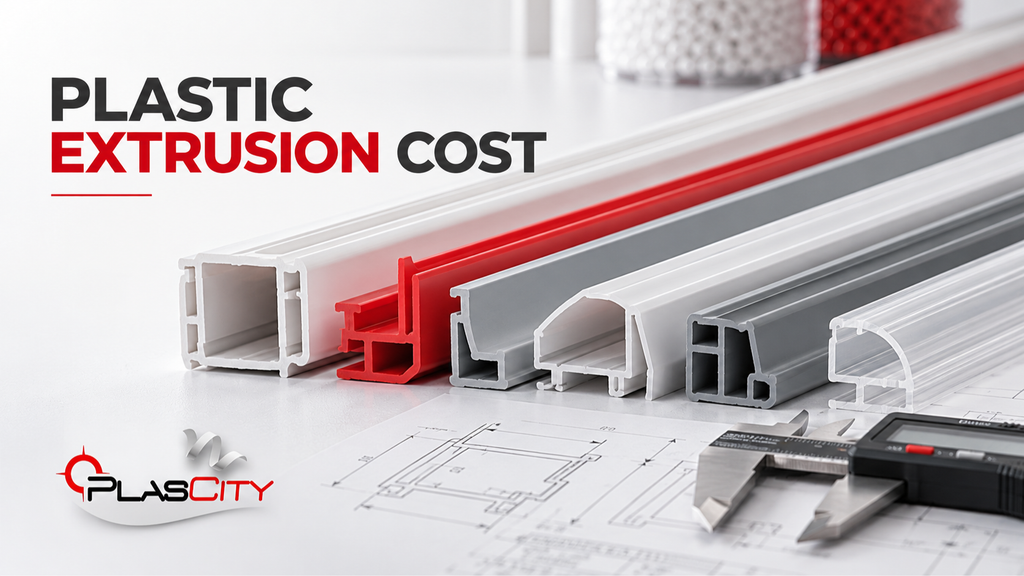
What Changes the Price Per Metre
Every driver below moves one part of the formula. Tell us the last column, and your quote gets sharper.
| Driver | What it changes | What to tell us |
|---|---|---|
| Profile size and wall thickness | Weight per metre, so material cost | A physical sample or CAD file |
| Material and grade | Resin price per kg and density | The material, or the properties you need (UV, flexible, rigid) |
| Additives and colour | Cost of stabilisers and colour matching | Colour reference and outdoor exposure |
| Hollow or complex shape, tight tolerances | Line speed, scrap and inspection time | The two or three dimensions that must stay exact |
| Two materials in one profile | Die complexity and careful, slower running | Which surfaces need the second material |
| Finishing | Finishing per metre | Cut length, holes, printing and packing method |
| Order size | Die and setup share per metre | First order quantity and yearly volume |
| Delivery terms and unit | The basis of the number you see | City or port, trade term, metre or foot |
DFMA puts finishing at 5% to 20% of cost, and notes that complex hollow shapes run slower. Lakeland Plastics, a US extruder, says tight tolerances can slow production and raise scrap.
We saw this first hand on our own work. One profile matched the customer’s drawing perfectly but did not fit smoothly on their assembly line. That is why we ask about assembly, operating conditions and critical fits before we price.
Why Two Quotes for the Same Profile Do Not Match
Buyers often tell us a competitor is cheaper. Many have not asked which material the price is for.
That is the most common gap we see. In our experience, a higher price is often explained by virgin material and strength enhancing additives, not by overcharging. Virgin material is plastic made fresh from raw resin, not reprocessed.
Before you compare two quotes, make these three lines match:
| Line | Ask | Why it moves the price |
|---|---|---|
| Weight per metre | Grams per metre and wall thickness | Less plastic per metre means a lower price per metre |
| Material, grade and additives | Which plastic, which grade, virgin or reprocessed, and any UV or strength additives | Resin cost and additive cost differ widely |
| Scope and terms | Unit (metre, foot, kg or piece), die included or separate, finishing, trade term | A different scope gives a different number |
Check the unit too. One metre is 3.281 feet, so USD 1.00 per metre is about USD 0.305 per foot.
Want the full story on reprocessed plastic? Read how to spot recycled plastic before it wrecks your product. For what to send with an enquiry, see our bulk ordering guide.
For trade terms and import checks, read our guide for OEM buyers sourcing from Pakistan.
Resin Price Movement and Quote Validity
Resin is the one cost that neither buyer nor manufacturer controls.
Weekly reports from PolymerUpdate show PP prices in Asia rising in early February 2026, falling sharply in late June and rising again in September. DFMA notes that resin prices can change weekly, and that extruders may use surcharges or index linked pricing on long contracts.
Here is what that means in money. Take the 280 g per metre PVC example. A resin move of USD 0.10 per kg changes the material cost by USD 0.028 per metre.
On a 3,000 metre order, that is USD 84. On 100,000 metres, it is USD 2,800. These are arithmetic examples, not our prices.
So a quote is a snapshot of the market. Ask every manufacturer three questions:
- How long is this price valid?
- Is it fixed for the whole order, or reviewed if resin moves?
- If the price can change, how will you show me the change?
At PlasCity, a quote is usually valid for 3 weeks. The period can vary with material pricing.
If the cost of raw material changes during that time, we tell you what changed and why. The usual cause is a rise or fall in fuel prices, which can feed through to raw material cost.
This does not happen often, and it can go down as well as up. But we do not hide it, because you should always know why a price moved.
People also search for the price of PP in Pakistan. We do not publish a resin rate here, because it would be out of date within days. Ask for a dated quote instead.
Bulk Pricing and the 3,000 Metre Minimum
Volume lowers the price per metre, but only part of it.
The die cost and the setup spread across more metres. Material and line time do not shrink much, because every metre still needs the same plastic and the same line time.
So volume helps the smaller parts of the price, not the biggest one. Our die cost guide has an example table that shows the die share falling as metres grow.
Our minimum order quantity (MOQ) for extrusion is 3,000 metres. The reasons and the setup steps are in our bulk ordering guide.
How PlasCity Builds a Custom Profile Quote
This is the method we follow, step by step:
- You send a physical sample or CAD file, with your material need, colour, piece length and quantity.
- We measure the profile and work out how much material each metre uses.
- We review your application and tolerances before we price anything.
- We confirm the material and grade. We use virgin material by default and add strength enhancing additives where the job needs them.
- We cost the die and the line. Die costing is free.
- We add finishing and packing, then send you the quote with the material, unit and scope written on it. The quote is usually valid for 3 weeks.
We cannot price from a photo alone, because a photo hides size, wall thickness and tolerances. Our bulk ordering guide shows exactly what to send.
FAQ: Plastic Extrusion Cost
How much does plastic extrusion cost per metre?
There is no single number. The price depends on weight per metre, material, scrap, line time, finishing and your order size. Send a sample or CAD file and we calculate it for your profile.
Why is my quote higher than another manufacturer’s?
Compare weight per metre, material and grade, and scope. A lower quote may use less material, reprocessed plastic, or leave out the die or finishing.
Can you quote from a picture?
No. A picture does not show size, wall thickness or tolerances. We need a physical sample or a CAD design.
What is your minimum order?
3,000 metres for extrusion and 5,000 pieces for injection moulding.
Does the price include the die?
That depends on how a quote is written. Ask for the die as a separate line, so you can compare like with like. Our die costing is free.
Does a resin price change affect my quote?
It can, but not often. Our quotes are usually valid for 3 weeks. If raw material cost changes in that time, we tell you what changed and why, whether the price went up or down.
What is the price of PP in Pakistan?
It changes with the market, so we do not publish a rate. Ask for a dated quote for your grade and quantity.
Request a Quotation
Send us your sample or CAD drawing, the material or properties you need, colour, piece length and quantity. Tell us where the profile will be used.
We respond within 1 business day. Request a quotation.
See how we work in our manufacturing process and quality checks. New to extrusion? Start with how plastic extrusion works.
About PlasCity
PlasCity is a third generation, family run custom plastic extrusion and injection molding manufacturer in Ferozewala, Punjab, Pakistan. We have served OEMs and industrial manufacturers since 1978.
We run 13 extrusion lines with about 600,000 metres of profile capacity per month, and we develop dies and molds in house. We work with PVC, ABS, HDPE, PP, LDPE, LLDPE, PET, Nylon and Polycarbonate, made to customer drawings, CAD files and specifications.
Contact PlasCity
- Business: PlasCity | Custom Extrusion Plastic Profiles and Parts Manufacturer
- Address: Phase 1 Al Rehman Garden, Ferozewala, Shahdara, Punjab, Pakistan
- Phone: +92 322 1146074 and +92 331 1146064
- Website: plascityextrusion.com
- Email: info@plascityextrusion.com
- Google Business Profile: https://share.google/A3vJt8LgFViPkTJ8o
- Google Maps: https://maps.app.goo.gl/TiDUn6o4ZyPWf5Ea8