Written by Usama Khan, PlasCity. Reviewed and last updated August 3, 2026.
Plastic extrusion is a manufacturing process that melts raw plastic and pushes it through a shaped die to create a continuous product with the same cross section all the way through, things like pipes, channels, trims, tubing, and custom profiles. It is the process behind window frames, weather stripping, HVAC ducting, medical tubing, and hundreds of everyday plastic parts. If you need long, uniform plastic shapes made to a specific design, extrusion is almost always the right process, and the manufacturer you choose determines whether that part shows up on time, fits correctly, and holds up under real use.
This guide covers what the process actually looks like on the factory floor, where buyers usually get burned, how extrusion compares to injection molding, and what questions actually separate a reliable manufacturer from one that will cause you problems six months into production.
Plastic Extrusion at a Glance
| Feature | Details |
|---|---|
| Process | Plastic Extrusion |
| Materials | PVC, ABS, HDPE, PP, LDPE, LLDPE, PET, Nylon, Polycarbonate |
| Products | Pipes, Channels, Tubes, Trims, Window Profiles, Industrial Components |
| Tooling | In-house Die Design & Development |
| MOQ | Custom Manufacturing Projects |
| Typical Tooling Lead Time | Around 10 Days |
| Manufacturing Since | 1978 |
| Production Lines | 13 Active Extrusion Lines + 3 Backup Lines |
| Monthly Production Capacity | Approximately 600,000 Meters |
| Location | Ferozewala, Lahore, Punjab, Pakistan |
| Markets Served | Pakistan, Middle East, Europe |
What You’ll Learn
| Question | Where to find it |
|---|---|
| What is plastic extrusion and how does it work | What Is Plastic Extrusion section |
| What real problems come up when sourcing extrusion | The Real Problems Buyers Run Into |
| How is extrusion different from injection molding | Plastic Extrusion vs Injection Molding |
| Which materials are used and why it matters | Materials Used in Plastic Extrusion |
| How to actually choose a manufacturer | How to Choose a Plastic Extrusion Manufacturer |
| Mistakes that cost buyers money | Common Mistakes Buyers Make |
| Who PlasCity is and what we deliver | Why Buyers Choose PlasCity |
PlasCity Manufacturing Snapshot
Before diving into the extrusion process, here is a quick overview of PlasCity’s manufacturing capabilities.
- Manufacturing custom plastic profiles since 1978
- Third-generation family-owned manufacturer
- 13 active extrusion lines supported by 3 backup production lines
- Approximately 600,000 meters of monthly extrusion capacity
- Typical new tooling development in around 10 days
- Delivered 40,000 HVAC components in 11 days
- Produced 50,000 meters of food-grade and medical tubing in only 6 days
- In-house CAD design, die manufacturing, tooling development, and quality control
- Serving OEM manufacturers throughout Pakistan, the Middle East, and Europe
What Is Plastic Extrusion
Plastic extrusion starts with raw plastic in the form of pellets, granules, or powder. These get fed into a hopper, then pushed through a heated barrel by a rotating screw. The heat and the mechanical pressure from the screw melt the plastic into a thick, even liquid. That molten plastic is then forced through a die, a metal tool shaped like the exact profile you need, whether that is a simple round tube or a complex multi chamber channel.
Once the plastic comes out of the die in its new shape, it passes through a cooling stage, usually a water bath or air cooling system, so it hardens into a solid, stable profile. From there it gets pulled through at a controlled speed, cut to length, and inspected for dimensional accuracy, wall thickness, and surface finish.
The reason this process is so widely used is simple: it is one of the few manufacturing methods that can produce very long, consistent lengths of plastic efficiently. A pipe, a window channel, or a cable duct does not need to be molded piece by piece. It just needs to keep the same shape for meters or kilometers, and extrusion does exactly that.
For a broader technical overview of the manufacturing process, see the Wikipedia article on plastic extrusion.
See our full manufacturing process.
The Real Problems Buyers Run Into
Reading about the process is one thing. Actually sourcing extrusion for your project is where most of the pain happens, and it usually is not the process itself that causes problems. It is the supplier.
The part looks right on paper but does not fit in the field. This happens when a manufacturer copies your drawing exactly without asking about how the part will actually be installed, what it connects to, or what conditions it will face. A profile can match every dimension on a drawing and still not seat correctly on an assembly line because nobody asked about the mating part.
Lead times slip without warning. This is especially common with overseas suppliers where communication is slow and a single miscommunication about material or tooling can cost weeks. When a production line is waiting on a shipment that is now late, that delay has a real cost attached to it.
Inconsistent quality between batches. Color variation, warping, brittleness, or dimensional drift between one production run and the next usually points to a manufacturer using inconsistent raw material, often recycled plastic that has already been through multiple heat cycles and lost strength.
The cheapest quote turns out to be the most expensive decision. A lower price is frequently explained by cheaper material, not a better deal. Virgin, pure plastic with the right additives costs more than plastic that has been recycled five or six times, but that recycled material has already lost strength and dimensional stability. The savings on the invoice show up later as field failures, returns, or a part that simply will not hold up.
If any of this sounds familiar, the fix is not switching processes. It is being more deliberate about who you choose to run that process for you, which is covered further down.
Plastic Extrusion vs Injection Molding
Buyers often ask which process they actually need. The short answer is that it depends on the shape.
| Factor | Plastic Extrusion | Injection Molding |
|---|---|---|
| Best for | Continuous, uniform cross sections (pipes, channels, trims, tubing) | Complex, three dimensional parts (housings, gears, connectors) |
| Tooling cost | Lower upfront cost, die based tooling | Higher upfront cost, full mold tooling |
| Shape complexity | Limited to a consistent 2D profile along its length | Supports intricate 3D geometry and fine detail |
| Typical output | Long continuous lengths, cut to size | Individual discrete parts |
| Good fit for | High volume runs of the same profile | Parts needing tight tolerances and complex features |
If your part needs to be the same shape along its entire length, extrusion is almost always cheaper and faster to set up. If your part needs to be a fully three dimensional shape with fine detail, injection molding is the better process. Some projects use both, extruded profiles for the structural shell and injection molded components for the connectors or fittings.
Materials Used in Plastic Extrusion
The material you choose affects strength, flexibility, chemical resistance, UV stability, and cost. Common materials include:
- PVC, widely used for rigid profiles, window channels, and construction applications because of its durability and weather resistance
- ABS, valued for impact resistance and a smooth finish, common in housings and consumer facing parts
- HDPE, used where chemical resistance and flexibility matter, common in piping and industrial applications
- PP, a lightweight, cost effective option used across packaging and industrial parts
- Engineering plastics such as LDPE, LLDPE, PET, Nylon, and Polycarbonate, used when a project needs specific mechanical or thermal performance beyond standard commodity plastics
A manufacturer that only works with one or two materials will steer every project toward what they already have on hand, whether or not it is the right fit. A manufacturer with broader material capability can actually recommend the material based on your application instead of their limitations.
How to Choose a Plastic Extrusion Manufacturer
Before requesting a quote, it helps to know what actually separates a dependable manufacturer from one that will cause problems later.
Questions to ask before requesting a quote:
- Do you review the application and operating environment, or just quote off the drawing
- What is your in house tooling and die development capability
- Can you show dimensional accuracy, wall thickness, and surface finish data from a past run
- What happens if my design needs a revision after the first trial samples
- What is your realistic lead time for tooling and for production, not just the best case
- Can I get a physical sample before committing to a full production run
- What quality checks happen during and after extrusion, not just at final inspection
What to check before selecting a supplier:
- In house die and mold design, so tooling changes do not depend on a third party
- A track record with your specific material, not just plastic extrusion in general
- Willingness to ask about your application, assembly method, and operating conditions before quoting
- Clear quality control steps during production, not just a final inspection at the end
- Certifications relevant to your industry, such as ISO compliance or food grade certification if applicable
- Proof of handling both prototype runs and full scale production, since some shops can do one but not the other
Independent manufacturing buyer guides also recommend evaluating tooling capability, quality systems, engineering support, and production consistency before selecting a supplier.
Common Mistakes Buyers Make
The most frequent mistake is treating a custom profile like a catalog product, sending a drawing and expecting the manufacturer to fill in the blanks. Important context like UV exposure, chemical exposure, temperature range, and how the part will be assembled or disassembled often gets left out, and a manufacturer that says yes immediately without asking questions is often the one that will cause the most problems later.
The second most common mistake is choosing a supplier on tooling cost or unit price alone. Tooling is a one time cost. Material quality and dimensional consistency affect every single part that comes off that tooling for the life of the program.
Why Buyers Choose PlasCity
Today, PlasCity operates 13 active extrusion lines, supported by 3 backup production lines, with a combined production capacity of approximately 600,000 meters of plastic profiles every month. New extrusion tooling is typically developed within 10 days, allowing customers to move from concept to production quickly. Recent projects include manufacturing 40,000 HVAC components in 11 days and producing 50,000 meters of food-grade and medical tubing in just 6 days, demonstrating our ability to manage demanding production schedules while maintaining quality standards.
We work across PVC, ABS, HDPE, PP, and engineering plastics including LDPE, LLDPE, PET, Nylon, and Polycarbonate, manufactured to customer drawings, CAD files, and technical specifications. We are ISO compliant and food grade certified, with multi stage quality control at every step of production.
Real examples of what that capability looks like in practice: we delivered 40,000 HVAC components in 11 days, and 50,000 meters of food grade and medical tubing in 6 days. We run 13 extrusion lines, with a typical tooling lead time of about 10 days for a new die, and a combined production capacity of roughly 600,000 meters of extruded profile per month. We serve HVAC, refrigeration, construction, food processing, retail display, LED lighting, industrial equipment, medical, agriculture, furniture, electrical, and engineering industries, with a focus on consistent quality, reliable lead times, and long term manufacturing partnerships for businesses across Pakistan and international markets.
One example of how this plays out in practice: a refrigeration equipment manufacturer came to us after struggling with inconsistent imported PVC profiles for their glass door and wire shelf assemblies. Before quoting, we reviewed their application and tolerances and suggested in house die design changes that reduced material use and improved fit. New tooling was built in about two weeks, trial samples went through full dimensional and fit checks, and after one round of adjustment the part moved into production with in process monitoring and batch traceability. It was delivered on schedule, and the customer has placed repeat orders since.
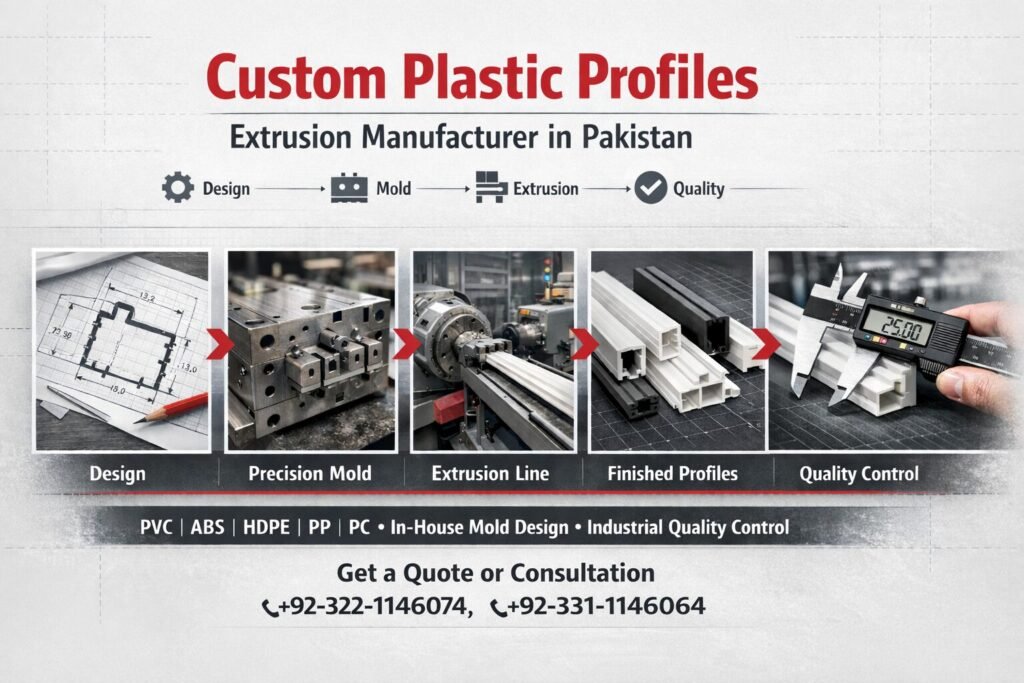
Frequently Asked Questions
What is plastic extrusion? Plastic extrusion is a manufacturing process that melts raw plastic and forces it through a shaped die to create a continuous profile with a consistent cross section, such as pipes, channels, trims, and tubing.
How does plastic extrusion work? Plastic pellets are fed into a heated barrel, melted by a rotating screw and heaters, forced through a shaped die, cooled to harden the shape, then pulled through and cut to the required length.
What are the best plastic extrusion companies? The strongest options are manufacturers that combine in house tooling capability, a track record across multiple materials, clear quality control during production (not just at the end), and a willingness to ask about your application before quoting rather than just copying a drawing.
See what actually drives plastic extrusion pricing before you compare quotes
How do I find a plastic extrusion manufacturer near me? Look beyond distance alone. A nearby supplier helps with logistics and communication, but process fit, material capability, and quality systems matter more than proximity. Request samples and past project examples before deciding.
What is the difference between plastic extrusion and injection molding? Extrusion produces continuous, uniform cross section shapes like pipes and profiles using a die, while injection molding produces discrete, three dimensional parts using a closed mold. Extrusion generally has lower tooling costs and suits high volume continuous shapes, while injection molding suits complex geometry and fine detail.
Get a Custom Plastic Extrusion Quote
Whether you already have a CAD drawing, a physical sample, or simply an idea for a new product, our engineering team can help.
Before providing a quotation, we review your application, recommend suitable plastic materials, estimate tooling requirements, identify opportunities to improve manufacturability, and provide clear production recommendations based on your project.
From prototype development to high-volume manufacturing, PlasCity supports businesses across Pakistan, the Middle East, and international markets with reliable custom plastic extrusion solutions.
Contact our engineering team today to discuss your project.
Phone: +92 322 1146074 / +92 331 1146064
Email: info@plascityextrusion.com
Address: Phase 1 Al Rehman Garden, Ferozewala, Lahore, Punjab, Pakistan
Google Business Profile: View PlasCity on Google Business Profile
Website: plascityextrusion.com
This is a quick overview. For the complete step by step breakdown, see our Plastic Extrusion Guide, or explore our Plastic Profile Extrusion services.