If you need custom plastic parts and your import is stuck because of the Strait of Hormuz closure or Red Sea shipping disruption, a custom plastic manufacturer in Pakistan like PlasCity can produce your part locally in 1 to 2 days. No bulk container order, no full advance payment, no LC. You can see exactly how this works on our services page.
I want to talk to you about something that is happening right now, not something that might happen someday.
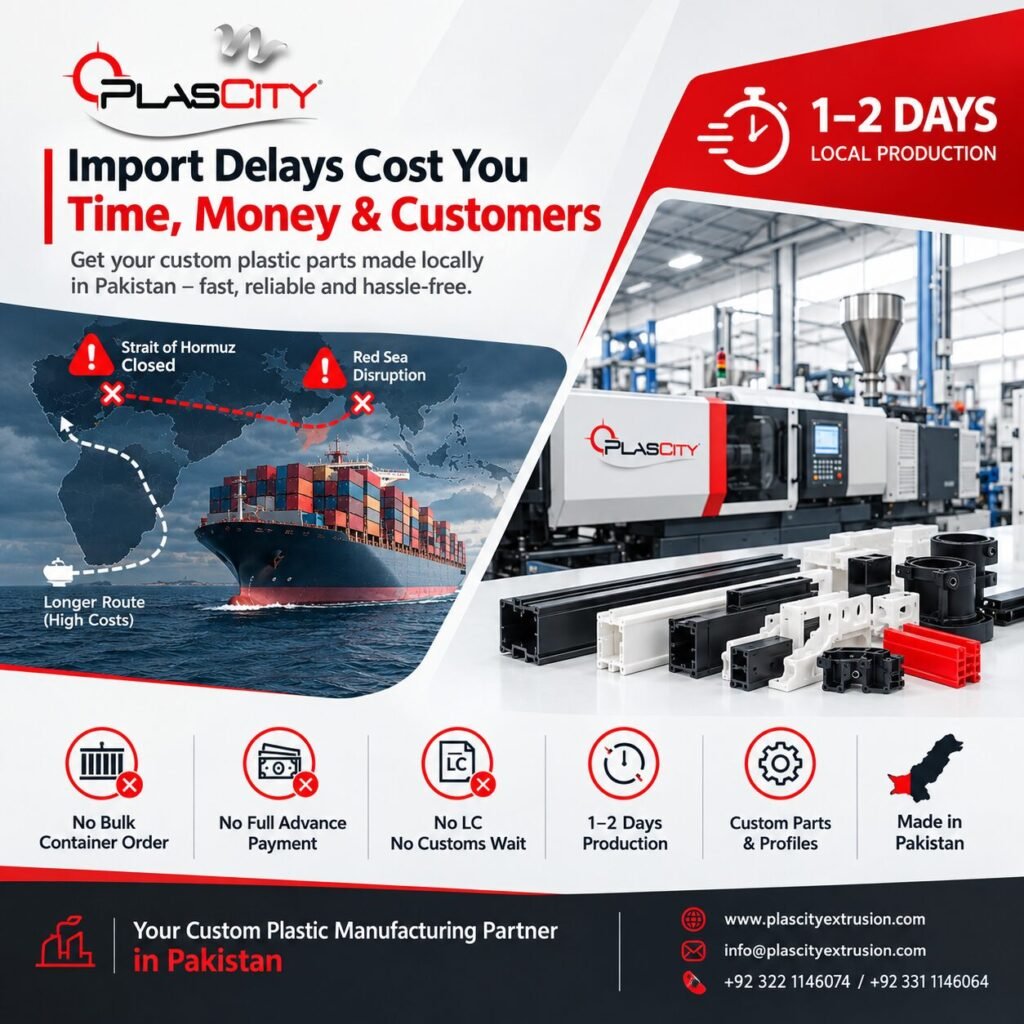
Since 28 February 2026, the Strait of Hormuz has been effectively closed to normal commercial shipping. That is not an opinion, it is the tracked reality. On a normal day, around 85 ships pass through that strait. On 6 September 2026, only 6 did. Iran has laid mines, boarded ships, and declared the strait shut, and the fighting has already cost lives at sea.
A month after that, in late March 2026, the Houthis in Yemen entered the same war and started threatening the Red Sea and the Bab el Mandeb strait too. That is the other route ships use to avoid Hormuz. So right now, both shortcuts are unsafe or unusable at the same time. That has never happened together like this before.
If you are an importer sitting on a container that has not moved in weeks, this is why. It is not your supplier being lazy. It is not your freight forwarder hiding something from you. Two of the busiest chokepoints on earth are jammed at once.
Every ship that still wants to move has to go the long way around Africa. That is the same detour carriers were forced into during the 2024 and 2025 Red Sea crisis, adding weeks and real cost to every shipment.
Why Import Delays in Pakistan Are Not a New Problem
Here is the part a lot of people forget. Pakistan has been through this exact pain before, and not because of a war overseas.
Back in 2022 and 2023, the State Bank of Pakistan introduced a prior approval policy for imports because of a dollar shortage. Businesses could not open LCs without that approval, and when approvals were delayed, containers sat at the port with goods already paid for, going nowhere. It got bad enough that Toyota and Suzuki both announced partial plant shutdowns in Pakistan because they could not clear the raw material they needed.
Indus Motor Company’s own CEO told Reuters at the time that deliveries would be delayed by months. Prices would have to be revised because the dollars simply were not there.
So the pattern is not new. LC delays, import restrictions, and stuck containers have hit Pakistani businesses before, for currency reasons. Now the same pain is showing up again, this time for a completely different reason, a war blocking two shipping lanes. Different cause, same result: your money is out the door and your product is not in your hands.
How an LC Actually Traps Your Money During a Crisis Like This
A letter of credit sounds like a safety net. In practice, during a disruption, it becomes the thing that locks your capital in place.
Once your LC is opened, your bank has effectively committed funds against that shipment, whether or not the goods ever move. If the ship carrying your order is sitting off Bandar Abbas, or rerouted around Africa, your LC does not pause. The clock and the paperwork keep running.
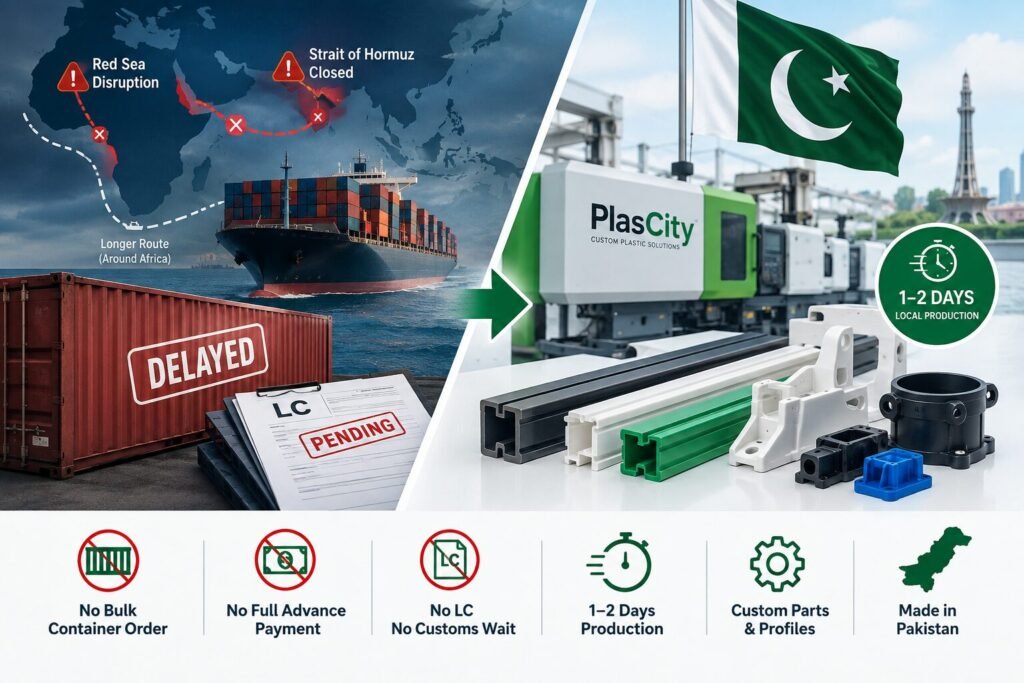
Many LCs carry expiry dates and shipment deadlines written into the terms. If a shipment cannot move in time because a strait is blocked, you may need a costly and time consuming amendment just to keep the LC valid at all.
This is exactly the kind of thing that happened during Pakistan’s 2022 to 2023 dollar shortage. Approvals stalled, LCs sat half processed, and businesses had money committed to goods they could not touch or use.
None of that risk exists when the manufacturing happens inside Pakistan. There is no LC in the process at all.
What Customs Clearance Adds on Top of the Wait
Even once a delayed shipment finally reaches a Pakistani port, the story is not over.
Customs clearance is its own separate stage, with its own paperwork, valuation checks, and inspection queue. Depending on the product category and documentation, this can add days or weeks after the ship has already arrived.
Pakistan’s import framework applies customs duty and sales tax based on the specific tariff code of the product, and general sales tax on imports typically runs in the 12 to 18 percent range depending on category. The exact duty rate depends on the product’s PCT code, so two similar looking plastic shipments can face different clearance timelines and different costs.
A shipment produced locally never enters this process. There is no tariff classification, no valuation dispute, and no customs queue standing between production and delivery.
What This Actually Costs the Person Who Ordered the Container
If you have lived through this, you already know the list. But it is worth saying out loud, because most articles about supply chain disruption skip the human part of it.
You paid the full amount, or most of it, before production even started, because that is how bulk container orders work.
Your LC is sitting open, your bank is asking for updates you cannot give them. Every week that passes is a week of capital that is not doing anything for your business.
You ordered a full container, not because you needed that much stock, but because that was the minimum the supplier would accept.
Once the shipment does eventually arrive, you still have customs clearance ahead of you. That is its own delay, its own paperwork, and sometimes its own additional cost.
And through all of it, your customers are asking you where their order is. “Stuck near Hormuz” is not an answer that keeps a business relationship intact.
Importing vs Local Custom Manufacturing, Side by Side
| Factor | Importing a container | Local custom manufacturing (PlasCity) |
|---|---|---|
| Payment terms | Often full or majority advance payment before production | No requirement for full advance payment |
| Minimum order | Bulk container quantities required by most overseas suppliers | No container minimum, small runs accepted |
| Financing | LC required, capital locked from opening to clearance | No LC needed |
| Customs | Duty and sales tax (roughly 12 to 18 percent GST range) plus clearance time | Not applicable, no border crossing |
| Exposure to shipping disruption | Directly exposed to strait closures, rerouting, and war risk | Not exposed, production stays onshore |
| Typical timeline | Weeks to months, longer during current Hormuz and Red Sea disruption | 1 to 2 days for most custom orders |
For Local Manufacturing learn to spot recycled plastic before it causes product problems.
A Real Example of What Switching Looks Like
One of our clients, a refrigeration equipment manufacturer, had been sourcing PVC profiles for glass doors and wire shelving through imports, with inconsistent quality between batches.
Before pricing the job, our team reviewed the application and tolerances and suggested in house die design changes that reduced material use and improved fit. New tooling was built in about two weeks, followed by trial samples with full dimensional and fit checks.
After one round of fit adjustment, the die was revised quickly, and the client moved into full production with in process monitoring and batch traceability. The order was delivered on schedule, and the client has placed repeat orders since.
That is the difference between waiting on a strait to reopen and having a supplier down the road who can adjust tooling in weeks, not months.
The Question Worth Asking Before Your Next Order
Not everything can be made locally. If you genuinely need a part that only exists overseas, this article will not pretend otherwise.
But a large share of what gets imported into Pakistan every year is custom plastic, extruded profiles, injection molded components, and OEM parts. These could be produced here, to the same drawing or sample, without ever touching a strait.
This is the actual gap in how this topic usually gets covered. Most content about the Hormuz and Red Sea crisis stays at the level of oil prices and freight rates. It rarely gets down to the person who is stuck holding a paid-for container of plastic parts and has no idea what to do next. That person is who this is written for.
If you plan to manufacture locally you need to know about OEM plastic supplier checklist.
This Is Not Only About One War
The Strait of Hormuz will reopen eventually. Wars end, shipping lanes clear, and this specific crisis will fade from the news.
But the underlying exposure does not go away just because the headline does. Pakistan has now been hit by this same kind of disruption twice in a few years, once from a currency and LC crisis, once from a war blocking two straits at the same time.
The businesses that come out ahead are not the ones hoping the next disruption never comes. They are the ones who already have a local manufacturing option in place before they need it.
For Buyers Outside Pakistan Watching Their Own Supply Chains
This is not only a Pakistan story. OEM buyers and procurement teams in the US, UK, and Australia sourcing custom plastic parts from regions affected by the same shipping lanes are facing the identical bottleneck.
Shifting even part of an order to a Pakistan based manufacturer with in house tooling does not require abandoning existing suppliers. It gives a buyer a second, unaffected production line for the parts that matter most when one route becomes unreliable.
How a Local Custom Plastic Manufacturer Removes Each Point of Pain
At PlasCity, we manufacture custom plastic extrusion profiles and injection molded parts in Lahore. Everything is built to your drawing or sample, in PVC, ABS, HDPE, PP, and several engineering plastics. Here is how that changes each part of the problem above.
No bulk container requirement. If you need 500 pieces instead of 50,000, we produce 500 pieces. There is no container minimum standing between you and your parts.
No full advance payment. You are not asked to pay the entire order upfront before anything is made. That is different from how a container order from overseas usually works.
No LC, no customs wait. Since production happens inside Pakistan, there is no letter of credit process and no customs clearance stage sitting between you and your stock.
Production in 1 to 2 days for most custom orders. Not the weeks or months a container currently needs to clear a strait that is still functioning at a fraction of normal traffic.
In house die design and tooling means your part is built to your exact specification, the same way an imported custom part would be, just without the ocean in between.
We serve HVAC, refrigeration, construction, food processing, retail display, and OEM manufacturing buyers who have been through exactly this kind of import bottleneck before. Our full product range is here if you want to see what is possible before you send a drawing.
If you are new to how plastic extrusion actually works before you get into sourcing decisions, our guide on what plastic extrusion is and how it works is a good place to start. And for the full picture of why manufacturers choose to work with us long term, our services page lays out every part of that process.
Useful Insights:
Get more detailed insights on:
1. Best plastics for extrusion in Pakistan’s hot climate to last longer
2. Custom plastic profiles made in Lahore that works best in Karachi
3. Why plastic parts fail and how to prevent it in various region of Pakistan
4. How to find Injection molding manufacturer in Pakistan
Frequently Asked Questions
Why are containers delayed right now in Pakistan and worldwide?
Since 28 February 2026, the Strait of Hormuz has been largely closed to commercial shipping due to the war between Iran, the United States, and Israel, with Iran laying mines and attacking vessels in the strait. Since late March 2026, Houthi forces in Yemen have also threatened the Red Sea and Bab el Mandeb strait, the main alternate route, forcing many ships onto a much longer path around Africa.
Is this the first time Pakistani importers have faced LC and import delays?
No. Pakistan went through a similar bottleneck in 2022 and 2023 when the State Bank of Pakistan required prior approval for imports due to a dollar shortage. That delayed LC approvals and left containers stuck at ports for months, at one point forcing Toyota and Suzuki to announce partial plant shutdowns.
How does a letter of credit add risk during a shipping crisis?
Once opened, an LC commits your bank’s funds against the shipment regardless of whether the goods actually move, and most LCs carry shipment deadlines. If a strait closure delays the vessel past that deadline, the LC may need a costly amendment just to remain valid.
Can a custom plastic part really be manufactured in Pakistan instead of imported?
Yes, for most custom plastic extrusion profiles and injection molded components. A manufacturer with in house tooling and die development, such as PlasCity, can take your drawing or physical sample and produce the part locally.
Do I need to order a full container to get custom plastic parts made in Pakistan?
No. Local custom manufacturing does not require a container minimum. Small and mid size production runs can be manufactured without the buyer committing to bulk quantities.
How long does local custom plastic manufacturing take compared to importing?
Most custom orders through PlasCity are completed in 1 to 2 days. An imported container currently affected by the Hormuz and Red Sea disruptions can take weeks longer than usual, on top of the standard shipping and customs timeline.
If your container is sitting somewhere it should not be right now, you do not have to wait for a war on the other side of the world to end before your production line moves again. Send us your drawing or sample, and let’s talk about what can be made here instead. Full details on how we work are on our services page.
📞 +92 322 1146074 / +92 331 1146064
✉️ info@plascityextrusion.com
🔗 Connect with PlasCity on LinkedIn
📍 Find us on Google Business Profile
Ready to bring production closer to home? See what we manufacture as a custom plastic parts manufacturer in Pakistan, or get a quote to compare against your current import lead times.