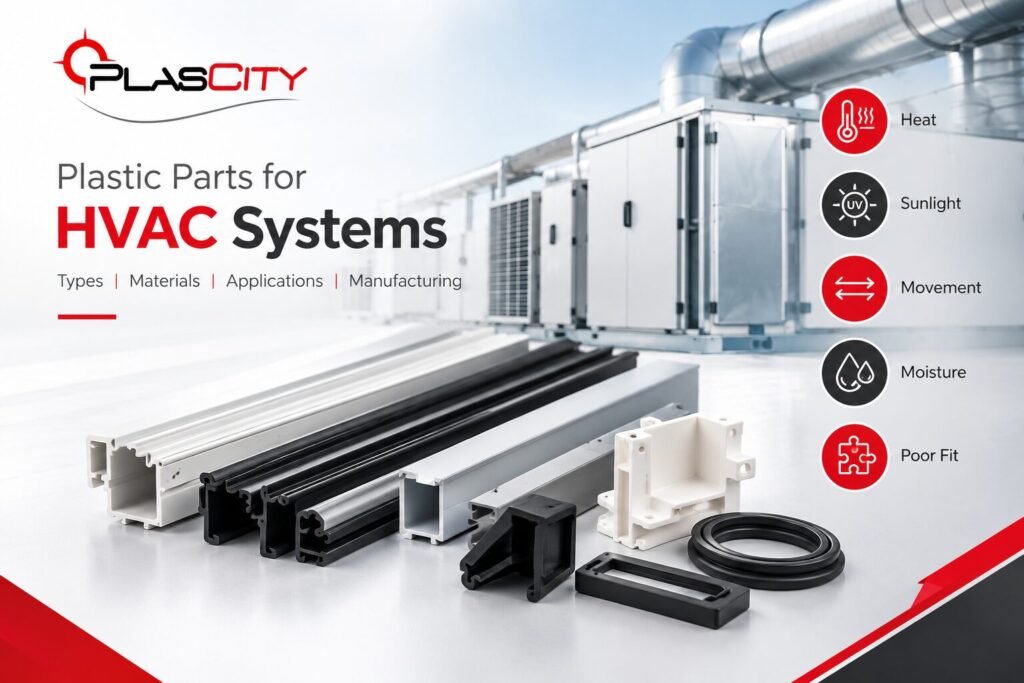
Quick answer: In our experience, most HVAC plastic part problems start before production. The material was chosen for the drawing, not for the place where the part will live. Five things cause the most trouble: heat, sunlight, movement, moisture and poor fit. Tell your manufacturer exactly where the part will be installed, and you can avoid many of them.
A plastic part in an HVAC system can look perfect on day one.
It passes inspection. It gets installed. Everyone goes home happy.
Then summer arrives.
That is when small mistakes begin to show. A snug strip becomes loose. A cover turns chalky. A seal stops sealing.
If you have ever opened a box of parts that did not fit, you know that sinking feeling. This guide is here to help you avoid it.
One number in the middle of this article may surprise you. A plastic strip only 3 meters long can grow by about the thickness of a pencil on a hot day. We will get there in reason number 3.
What You’ll Learn
| Section | What you will learn |
|---|---|
| The 5 reasons at a glance | A quick table you can screenshot |
| 1. Heat | Why a part can go soft sooner than you expect |
| 2. Sunlight | Why heat resistant does not mean sun resistant |
| 3. Movement | How much a plastic profile really grows |
| 4. Moisture | What standing water does inside an air handler |
| 5. Poor fit | Why a part can match the drawing and still not work |
| Fire and smoke rules | One rule that depends on where the part sits |
| Six questions | What to ask before you request a quote |
Why Small Plastic Parts Have Big Jobs
An HVAC system moves air. Plastic seals, joints and profiles help keep that air where it belongs.
When air escapes, the loss can be large. ENERGY STAR says that in typical homes, about 20 to 30 percent of the air moving through a duct system is lost through leaks, holes and poorly connected ducts.
That figure is about whole duct systems, not plastic alone. But seals and joints are part of the story.
So a tiny part can carry a big job. What makes it fail?
The 5 Reasons at a Glance
| Cause | What you may see | Ask this |
|---|---|---|
| Heat | Warping, sagging, loose fit | What is the hottest surface temperature, not just the air temperature? |
| Sunlight | Chalky surface, color change, cracks | Will sun ever touch this part? |
| Movement | Gaps, rattling, buckling | How long is the part, and how much does the temperature swing? |
| Moisture | Water that stays, dirt that builds up | Will water sit on or near this part? |
| Poor fit | Hard to install, air leaks | Was it tested with the real part it must fit? |
1. Heat: The Part Gets Soft Before You Notice
Here is a mistake that is easy to make. We look at the air temperature and forget the part temperature.
Direct sunlight or radiant heat can push a PVC product 30 to 50°F (about 17 to 28°C) above the air around it, according to PVC window profile maker Deceuninck. The same source says PVC can begin to soften above 150°F (about 65°C).
Now think about Lahore. The Government of Punjab says June highs here routinely pass 40°C. Add the sun, and a surface can come close to that softening point. (That last step is our simple math, not a lab result.)
Exact limits change with the grade. The material datasheet should decide, not a blog post and not a guess.
Next comes something that surprises many buyers.
2. Sunlight: Heat Resistant Does Not Mean Sun Resistant
These are two different powers.
A plastic can handle heat well and still suffer in sunlight. UV is the invisible part of sunlight. It slowly breaks plastic apart at a tiny level.
The result? The surface turns chalky. The color fades. Later the part can become brittle, which means it snaps instead of bending.
Some plastics are more sensitive than others. SpecialChem describes polypropylene as especially sensitive to UV light, and Safic Alcan lists polyethylene and polypropylene among the most vulnerable.
What about PVC? The Madison Group explains that strong, long UV exposure can cause embrittlement and chalking, and that the exact formulation matters.
How strong is the sun here? Weather Atlas lists an average maximum UV index of 12 for Lahore in June and July. That sits in the extreme range.
Think of a T shirt left in the sun all summer. Plastic can feel it too, unless protection is built in.
Not sure if sun ever reaches your part? Please ask. Even a short daily dose can add up over the years.
3. Movement: The Pencil Number
Here is the number I promised.
Rigid PVC grows about 0.06 mm for every meter of length for every 1°C of temperature change, according to Kalsi Plastics. That is roughly three times aluminum, which Inspectapedia lists at about 0.022 mm.
Let’s do the math for a 3 meter profile that goes through a 40°C swing.
- Rigid PVC grows about 7 mm.
- Aluminum grows about 2.6 mm.
Seven millimeters is about the thickness of a pencil. (This is our calculation from those published figures. Real grades vary.)
Why does it matter? A part that moves can leave gaps, rattle, or push on its neighbor until something gives.
If a profile was designed around a metal frame, plastic will not behave the same way. It needs room to move.
Reason number 4 is about water.
4. Moisture: Water Is Patient
Cooling coils pull water out of the air. That water drips into a drain pan and leaves through a drain.
The US EPA says standing water can collect in a drain pan that is not properly designed and maintained, and that becomes a place where microbes can live.
The EPA also says controlling moisture is the most effective way to keep mold from growing in air ducts.
Plastic parts near coils and drain pans, such as trims, guides and seals, live in that damp world for years. You can see this range in our AHU plastic parts page.
Here is our view as manufacturers. Shape matters as much as material. A trim that traps water in a corner can cause trouble, whatever it is made of. (This is our opinion, not an EPA statement.)
Did you notice we have not talked about price yet? That is on purpose. The last reason is the one that taught us the most.
5. Poor Fit: Right Drawing, Wrong Result
Let me share something from our early days.
We once made a profile that matched the customer’s drawing exactly. But it did not fit smoothly on the customer’s assembly line. A small die adjustment fixed it.
The drawing was right. So what was missing? We had not asked how the part would be installed and where it would work.
That lesson changed our process. Before we make a die, we now ask about the job of the part, how it is assembled, the operating environment, the volume, and which sizes matter most. We also ask for the mating part, the piece it must fit with, so we can test it in real conditions.
Two small words explain why. Tolerance means how much a size is allowed to vary. If it is too loose, air can leak. If it is too tight, the part may not go on at all.
That is also why a physical sample matters. You can hold it, fit it and test it before bulk production starts.
One More Thing: Fire and Smoke Rules
Some HVAC spaces have special fire rules. Spaces above suspended ceilings or below floors that carry air are called air handling spaces.
UL 2043 is a test for heat and visible smoke from separate products installed in those spaces. To pass, a product must show a peak heat release of 100 kW or less, along with low smoke limits. UL also notes that continuous piping or conduit is not treated as a discrete product.
Does your part need it? That depends on the building code, the project and the place it sits. We are a manufacturer, not a code authority, so please check with your project engineer.
Which Material Has Which Weak Spot?
There is no single best plastic for every HVAC part. Each family has a place where it needs extra care.
| Material family | Often used for | Watch out for |
|---|---|---|
| Rigid PVC | Channels, trims, guides, joint profiles | Softening near heat, and it needs UV protection outdoors |
| Flexible PVC | Seals and gaskets | Hardness must suit the sealing job, and it can age with heat and sun |
| PP | Parts that meet moisture | Needs a UV stabilizer for any sun exposure |
| ABS | Rigid covers and tracks | Needs UV protection for long sun exposure |
| Engineering plastics such as nylon and polycarbonate | Higher demand parts | Cost, and the exact grade |
This is general guidance only. The exact grade and formulation decide. You can read more on our materials page.
One more hidden cause is worth a mention. In our experience, some very cheap quotes rely on plastic that has been recycled many times, which may already have lost strength. It is fair to ask what material is being used. Our guide on how to spot recycled plastic shows what to look for.
Extrusion or Injection Molding? The 30 Second Version
Long, continuous shapes, like sealing strips and channels, are usually made by plastic extrusion.
Separate 3D shapes, like clips, covers and brackets, are usually made by injection molding.
Many HVAC assemblies need both. For the full comparison, see our guide to plastic extrusion manufacturing.
Quick Quote or Careful Manufacturer?
Two manufacturers can quote the same drawing and behave very differently. Here is what to look for.
| Topic | A quick quote | A careful manufacturer |
|---|---|---|
| First question | “Please send the drawing” | “Where will it be installed?” |
| Material talk | Names a plastic family | Discusses grade, heat, sun and movement |
| Sample | Optional | Approved before bulk production |
| Mating part | Rarely checked | Tested when possible |
| Tooling changes | Unclear who controls them | In house die and mold development, so changes move faster |
Four Mistakes We See Often
- Choosing by price alone.
- Treating heat resistance as sun resistance.
- Sending only a photo, without sizes or the place of use.
- Skipping the sample.
Six Questions to Ask Before You Request a Quote
- Where exactly will the part be installed: inside, outside, or near a coil?
- What is the hottest surface temperature, including sun?
- Will sunlight ever reach it?
- How long is the part, and how will it be fixed in place?
- Will water sit on or near it?
- Which mating part must it fit, and can we test with it?
What to Send Us
If you are developing a new HVAC part or replacing an imported one, please send:
- A drawing or CAD file, or a physical sample if you have no drawing.
- Where the part will be installed and the temperature range.
- Whether sun or water will touch it.
- Yearly quantity, if you know it.
- The mating part it must fit, if possible.
For one HVAC order, we delivered 40,000 components in 11 days. We share this only to show that speed and care can go together, and we still begin with the questions above.
We run 13 extrusion lines with about 600,000 meters of profile capacity per month. In many projects, a new die takes about 10 days.
We also make PVC PI insulation duct channels for HVAC.
If you are looking for an HVAC plastic parts manufacturer, our team will review your drawing, CAD file or sample and reply with honest questions first, and a quote after.
Frequently Asked Questions
Why do HVAC plastic parts crack or turn chalky?
Usually because of long sun exposure and heat. UV light slowly breaks down the plastic surface, causing chalking, color change and later brittleness. Some materials, like polypropylene, are more sensitive than others. A UV stabilized grade chosen for the real installation place can help.
Is heat resistant plastic also UV resistant?
No. Heat resistance and UV resistance are separate properties. A plastic can handle high temperatures and still turn chalky or brittle in strong sunlight. For any part that sees sun, ask about UV stabilization as well as temperature limits, and check the exact grade datasheet.
How much does a plastic profile expand in heat?
Rigid PVC expands about 0.06 mm per meter for every 1°C, roughly three times aluminum. A 3 meter profile with a 40°C swing can grow about 7 mm, against about 2.6 mm for aluminum. Real grades differ, so plan expansion room using the datasheet.
Can plastic HVAC parts be used outdoors?
Often yes, if the material is chosen for the job. Outdoor parts face sun, rain and surface temperatures higher than the air around them. Ask for a UV stabilized grade, confirm the heat limit for the exact formulation, and approve a sample first.
Do HVAC plastic parts need a fire rating?
It depends on the part, the building code and where it is installed. Separate products in air handling spaces may need testing such as UL 2043, while continuous items may be treated differently. Ask your project engineer or local authority before choosing a material.
What should I send a manufacturer to get an HVAC plastic part made?
Send a drawing or CAD file, or a physical sample if you have no drawing. Add where the part will be installed, the temperature range, sun exposure, yearly quantity and the mating part it must fit. The more real conditions you share, the better the material advice.
About PlasCity
PlasCity is a custom plastic extrusion and injection molding manufacturer based in Ferozewala, Punjab, Pakistan, serving OEMs since 1978. We are a third generation, family run business.
We manufacture custom plastic profiles and parts in PVC, ABS, HDPE, PP and engineering plastics such as nylon and polycarbonate, made to customer drawings, CAD files and samples. Our in house die and mold development means no catalogue limits.
We serve HVAC, AHU, refrigeration, construction, electrical, food processing, retail display, LED lighting, furniture, medical, agriculture, automobile and OEM manufacturing. See our industries page for more.
Contact PlasCity
PlasCity
Phase 1 Al Rehman Garden, Ferozewala, Shahdara, Punjab, Pakistan
Phone: +92 322 1146074 and +92 331 1146064
Email: info@plascityextrusion.com
Google Business Profile: PlasCity on Google
Google Maps: Find us on Maps
If you are sourcing HVAC components, see our HVAC plastic parts page for the profiles we manufacture for this industry.